


A new paper has been published in the Journal of Chemical Information and Modelling:
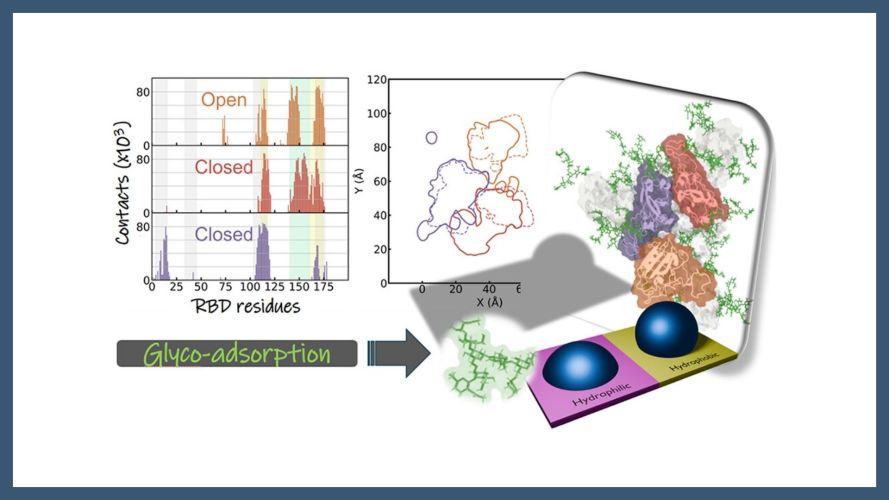
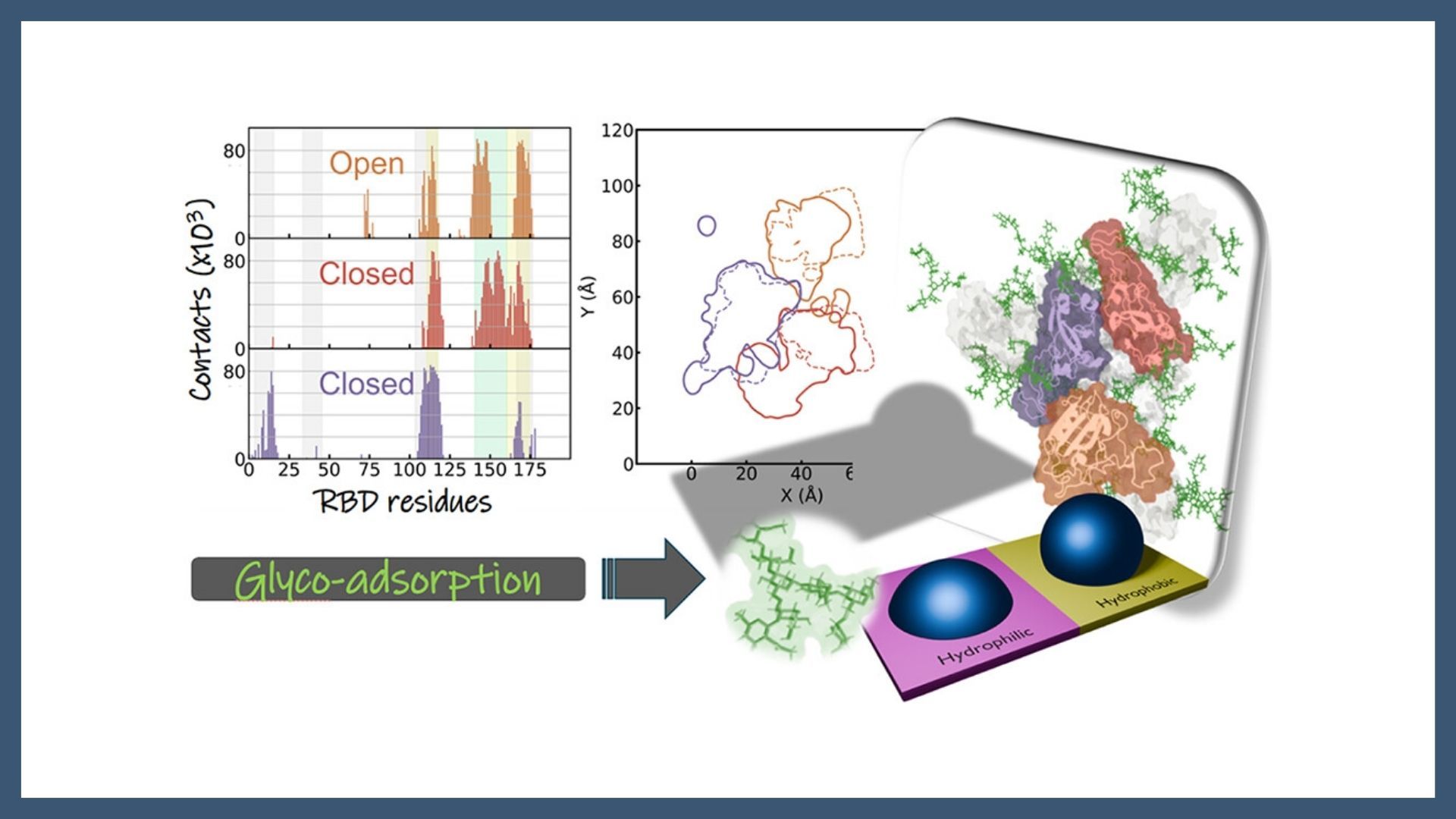
Numerous respiratory viruses are transmitted via airborne microdroplets that frequently adhere to fomites. Understanding the behavior of these phenomenologically rich bio-material interfaces remains an open issue. Here, we tackle the complex interplay between glycans and protein conformational dynamics during adsorption onto polarizable surfaces, focusing on the potential of glycans as molecular interaction modulators. We employ molecular dynamics simulations to dissect the interactions of the Receptor Binding Domain (RBD) glycoproteins from different SARS-CoV-2 variants of concern (VoC), in both open and closed conformations, with polarizable planar interfaces. Advanced analysis using 2D space reveals distinct adsorption mechanisms depending on the initial loci of the glycan within the protein wall. Hydrophobic surfaces facilitate stable adsorption for both RBD conformations. Conversely, hydrophilic surfaces exhibit reduced adsorption, particularly for the closed-RBD, where glycans predominantly form hydrogen bonds. Glycans significantly modulate closed-RBD adsorption, either enhancing it by permanent tethering or impeding it depending on the initial conformation and protein mutations (Omicron). Results for the individual RBDs are consistent with scaled-up simulations for the complete spike ectodomain glycoprotein. Our findings unveil novel glycan-mediated adsorption phenomena and provide fundamental insights into glycoprotein–surface interactions, paving the way for understanding glycan roles in glycoprotein–fomite adsorption, protein aggregation, and recognition at polarizable biological interfaces.
M4HTH Smart Nanomedicine
Glycans Modulate the Adsorption of RBD Glycoproteins on Polarizable Surfaces
Bosch-Fernandez, Antonio M.; Menacho, Willy; Perez, Ruben; Guzman, Horacio V.
DOI: 10.1021/acs.jcim.5c02363

