


A new paper has been published in the journal Microstructures.
Ferroelectric HfO2-based thin films are promising for next-generation non-volatile memories. Achieving further understanding of how the interfaces and defects influence switching dynamics and reliability is essential for device optimization.
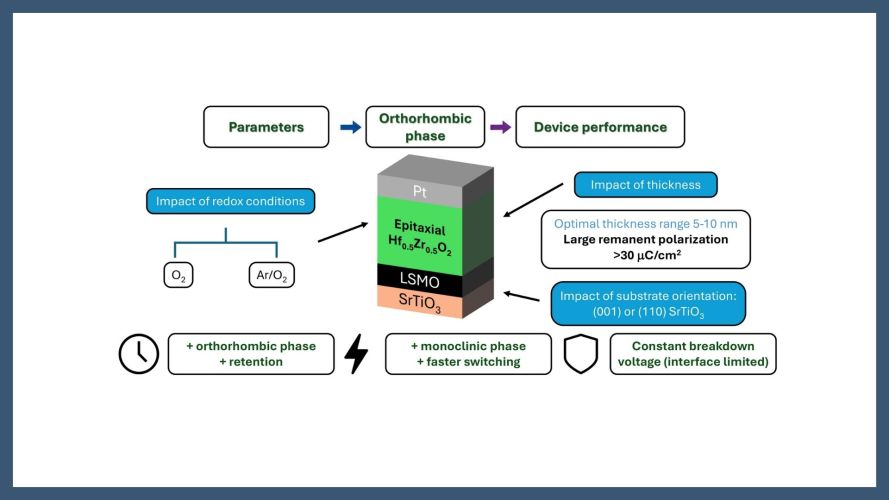
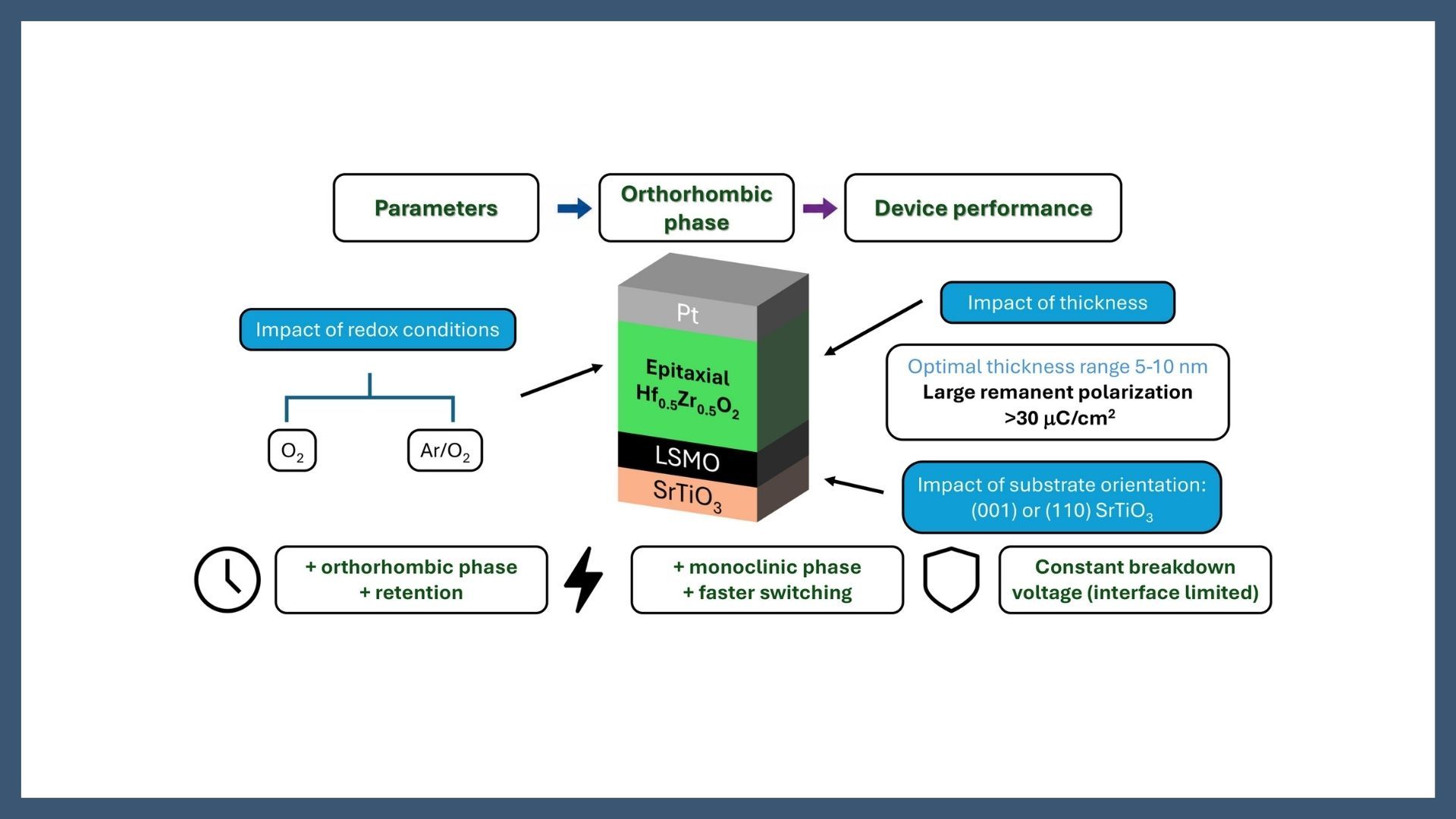
Here, we investigate the polarization switching kinetics, breakdown strength, and retention of a series of epitaxial Hf0.5Zr0.5O2 (HZO) of increasing thickness and grown using different oxidation conditions on substrates with different orientations.
Time-dependent ferroelectric characterization shows that films in the intermediate thickness range (≈5-10 nm), which exhibit the largest remanent polarization (above 30 μC/cm2), show slower switching. In addition, polarity-dependent switching kinetics is observed in ultrathin films, which is attributed to built-in electric fields associated with asymmetry between interfaces. Reliability analysis shows that the breakdown electric field decreases with increasing thickness, reaching up to ~55 MV/cm, while the retention remains stable in the optimal thickness range.
These results demonstrate that the interplay between film thickness, interface symmetry, and oxidation conditions during growth governs the switching dynamics and reliability of epitaxial HZO films, providing guidelines for the design of high-performance ferroelectric devices.
M4ELC Sustainable Electronics
Growth redox conditions and interface effects govern polarization switching speed, retention and reliability in epitaxial Hf0.5Zr0.5O2 thin films
Xueliang Lyu, Faizan Ali, Florencio Sánchez, Ignasi Fina
Microstructures 2026, 6, 20260126
DOI: 10.20517/microstructures.2026.97

