


This research was carried out in collaboration with the University of Chinese Academy of Sciences, the Nanomaterials and Nanotechnology Research Center (a center involving the University of Oviedo), the Catalan Institute of Nanoscience and Nanotechnology, the École Supérieure de Physique et de Chimie de Paris, and Chalmers University of Technology.
A new piece of a scientific puzzle
The authors of this study investigated two oxides that are insulating on their own but have long been known to generate, when joined together, an interface just a few atoms wide that becomes superconducting. “They are two boring rocks that are insulating on their own, but when they come into contact with each other, they generate an interface that is conductive and, at very low temperatures, even superconducting,” says Jaume Gázquez, one of the authors of the study.
It has long been known that vibrations of the atomic lattice can play an important role in the emergence of superconductivity. Now, the results of this work show that the atomic lattice vibrates differently precisely where the two materials come into contact. This vibration is confined to the same region of the interface where superconductivity emerges. This correlation suggests that these vibrations could be related to the phenomenon.
Another step toward understanding superconductivity
For Cooper pairs to emerge, some mechanism must promote the pairing of electrons. One hypothesis is that atomic vibrations may be involved. The new observation strengthens this possibility, although it does not conclusively demonstrate it: “We cannot unequivocally establish that superconductivity in this case is caused by this interface mode,” explains Gervasi Herranz. “But what is very important is that this had never been identified before.”
The researchers believe that this observation provides a new clue for understanding how this behavior emerges in systems such as these, where electrons are confined to extremely thin layers. In addition, the authors are continuing to study this phenomenon in other materials, and it may not be exclusive to the combination investigated here. “It is one piece of a puzzle that is still incomplete,” summarizes Jaume Gázquez.
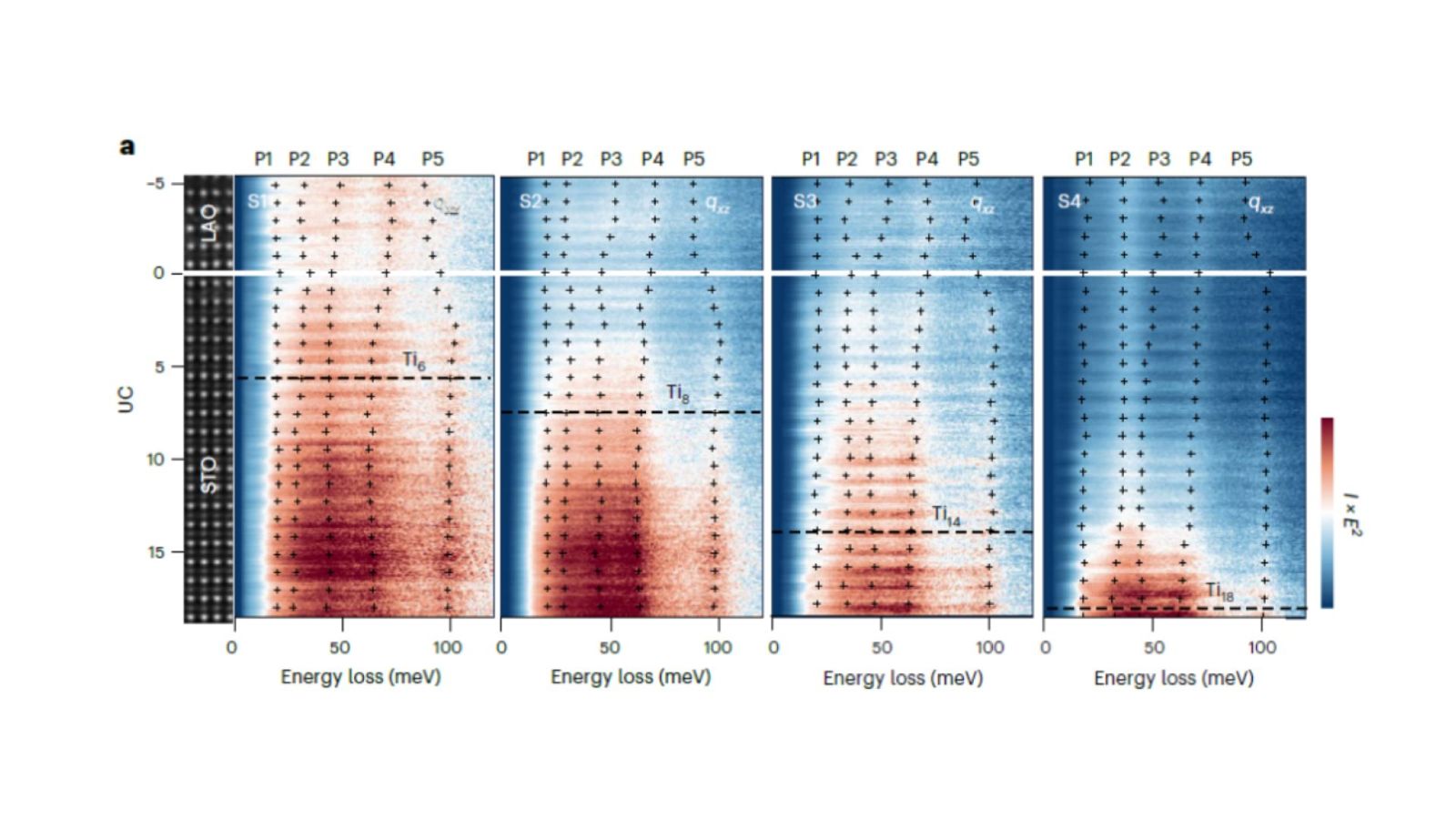
Atomically resolved spectra across some of the samples │ The authors
Seeing atoms move: A challenge that was until recently impossible
Shortly before this publication, a team made up of almost the same researchers had presented a methodology capable of observing the electronic structure atom by atom. Now, this same commitment to atomic-scale resolution also makes it possible to study atomic vibrations with an unprecedented level of detail.
Reference article
Electron–phonon coupling and symmetry breaking in superconducting oxide interfaces near ferroelectric quantum criticality
Guzman, R., Pruneda, M., Nery, J. P., Xu, M., Li, A., Wittemeier, N., Li, A., Singh, G., Bergeal, N., Kalaboukhov, A., Herranz, G., Gazquez, J., & Zhou, W.
Nature Materials, 2026
DOI: 10.1038/s41563-026-02647-x
> Read the press release in CAT, ENG, ESP
Related news