



A new paper has been published in Advanced Materials Interfaces:
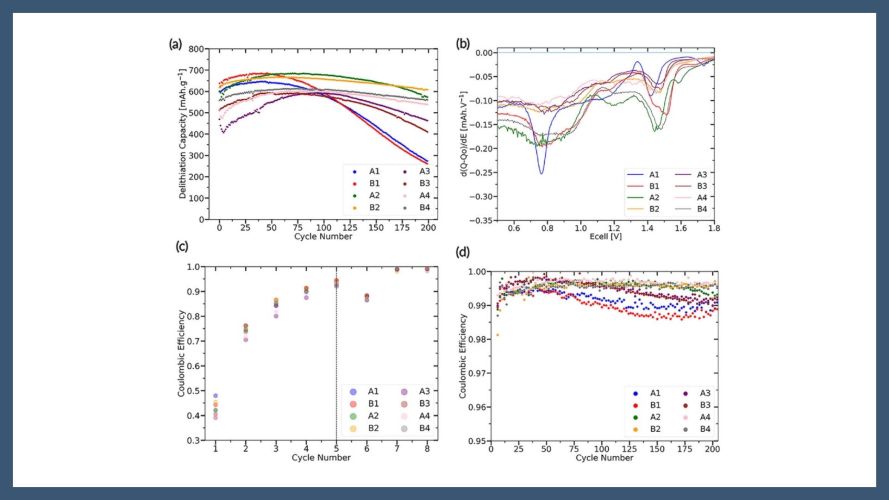
Silicon-based negative electrodes are essential for next-generation high-capacity Li-ion batteries, with SiO2 emerging as a promising and sustainable option. However, SiO2 anodes have limited cycling stability, which can be improved by tailoring the solid electrolyte interphase (SEI) through electrolyte engineering. This study investigates the effects of LiPF6 and LiFSI electrolyte salts, along with fluoroethylene carbonate (FEC) and vinylene carbonate (VC) additives, on the performance of SiO2 anodes. Galvanostatic cycling and electrochemical impedance spectroscopy (EIS) are combined with SEI composition analysis using Ar+-sputtered X-ray photoelectron spectroscopy and hard X-ray synchrotron photoelectron spectroscopy at different photon energies. The results show that FEC enhances capacity retention, while VC improves long-term stability at the expense of lower initial capacity. No synergistic benefits are observed from combination of both additives. LiFSI-based electrolytes deliver high initial capacities but suffer capacity fade over cycling, whereas additive-free LiPF6 formulations lead to poor cycling stability due to the formation of a thick and resistive SEI layer. In contrast, LiFSI promotes a thinner and more inorganic-rich SEI. Both FEC and VC lead to the formation of a poly(VC) surface layer that enhances capacity retention. The FEC-derived layer, enriched with LiF and thinner in nature, exhibits improved SEI stability. These findings provide valuable insights for designing electrolytes to improve the cycling performance of SiO2 anodes.
M4NRG Clean Energy
Improving the Cycling Stability of SiO2 Anodes for Li-ion Batteries by Controlling Solid Electrolyte Interphase Chemistry and Structure
Hua, Weicheng; Hjelseng, Kristianne Nilsen-Nygaard; Vinje, Jakob; Zuazo, Juan Rubio; Cova, Federico; Svensson, Ann Mari; Blanco, Maria Valeria
DOI: 10.1002/admi.202500530

