



A new paper has been published in Small:
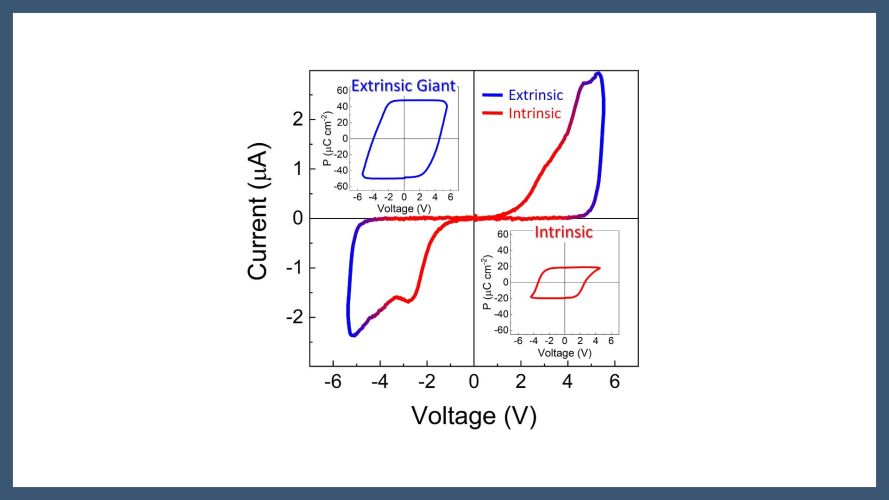
Fluorite ferroelectrics based on HfO2 and ZrO2 hold great potential for efficient memory devices. For these applications, it is of interest to control and maximize the remanent polarization. The literature shows a strong dispersion of polarization values for the same chemical composition. The measured values can include distinct contributions, and indeed, HfO2 and ZrO2 present prominent ionic transport, in addition to electronic processes. This can cause the genuine ferroelectricity of fluorites to be superimposed on extrinsic contributions, leading to the erroneous estimation of polarization. This possibility has a major impact, as it can seriously affect the system's understanding, hampering progress. To disclose genuine ferroelectricity, a comprehensive study of hafnium and zirconium oxide films is conducted. High-quality epitaxial films are prepared with different Hf1-xZrxO2 compositions, ranging from HfO2 to ZrO2, and using different deposition parameters and substrate orientation to vary defects and interfaces. There is resistive switching, especially in ZrO2 films, which results in hysteretic current and induces a considerable overestimation of the polarization in films with high leakage current levels. It is demonstrated that a critical evaluation of extrinsic contributions is necessary, especially when abnormally shaped polarization loops or anomalously high polarization values are measured.
M4ELC Sustainable Electronics
Intrinsic Ferroelectric Polarization in Doped HfO2 and ZrO2
Lyu, Xueliang; Zou, Jingye; Ali, Faizan; Fina, Ignasi; Sanchez, Florencio
DOI: 10.1002/smll.202506334

