


A new paper has been published in the Journal of Energy Storage:
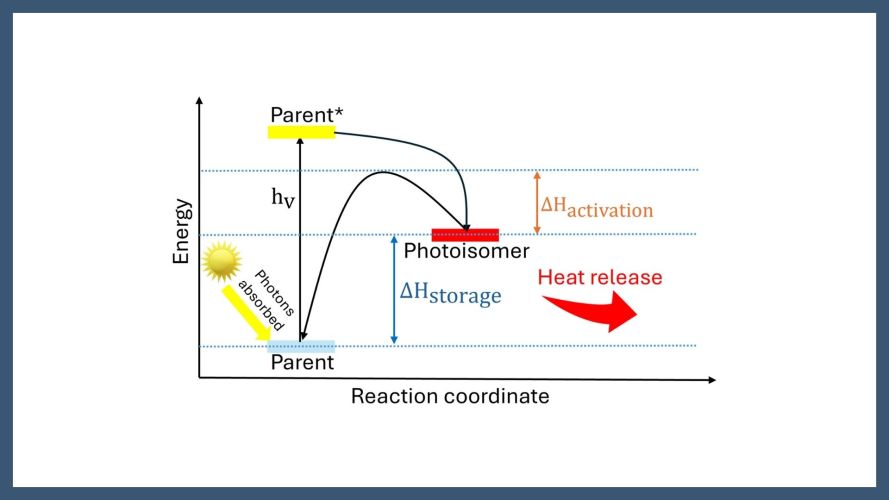
Molecular solar thermal storage (MOST) systems represent an emerging closed-loop technology with energy storage densities up to 1.6 MJ/kg, more than double that of typical phase change materials. MOST systems store solar energy in the chemical bonds of photoswitchable molecules via photoisomerization, releasing heat on demand during molecular reversion. Despite extensive research, their potential for domestic hot water co-heating remains unexplored. This study investigates the potential integration of MOST systems into a conceptual laboratory-scale co-heating device by combining experimental discharge characterization with numerical thermal simulations. Laboratory experiments evaluated the discharge characteristics of a norbornadiene-quadricyclane MOST system, demonstrating thermal activation for the first time under varying activation temperatures and residence times. A numerical thermal simulation model was developed to assess the performance of two norbornadiene-quadricyclane systems designed for short- and long-term storage. Parametric studies analyzed the impact of molecular properties and device design parameters on discharge and water heating performance. Laboratory results demonstrated 95–100% back conversion of quadricyclane to norbornadiene at a molecular concentration of 1.3 mol/L (290.2 g/L) in toluene. Simulations indicated activation-normalized water-heating ratios of 43–86% for the long-term system and 106–204% for the short-term system, assuming perfect insulation and current molecular and device constraints, representing idealized upper-bound estimates. Among the MOST molecular properties evaluated, thermal enthalpy had the strongest sensitivity effect on discharge and water-heating performance. Additional gains were achieved through increased energy storage capacity, optimized molecule concentration, and adjusted device operational temperatures. Future research should prioritize molecular enhancements, catalytic strategies to accelerate back-conversion, and device design optimization to minimize heat losses and improve scalability.
A new paper has been published in the Journal of Energy Storage:
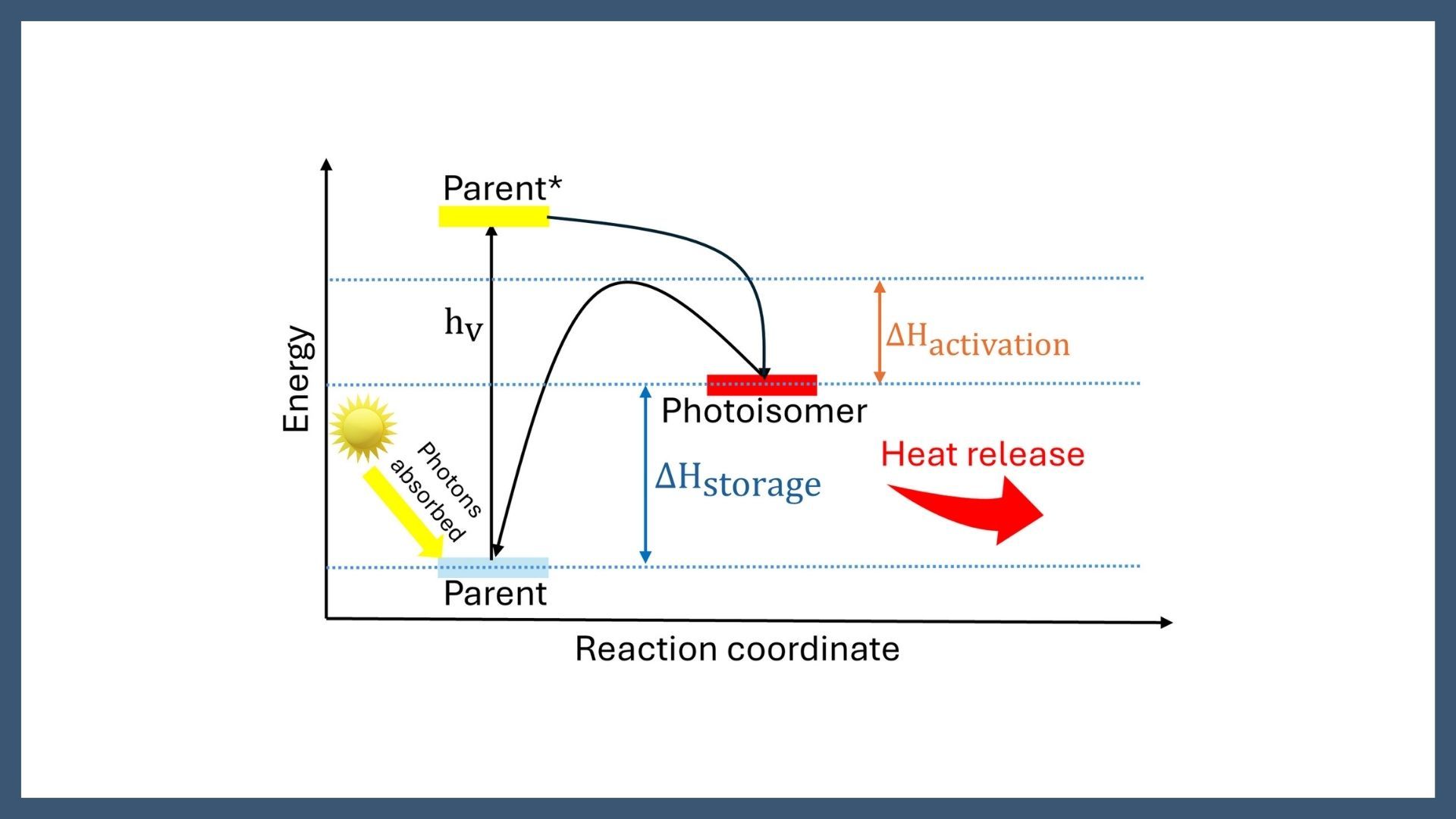
Molecular solar thermal storage (MOST) systems represent an emerging closed-loop technology with energy storage densities up to 1.6 MJ/kg, more than double that of typical phase change materials. MOST systems store solar energy in the chemical bonds of photoswitchable molecules via photoisomerization, releasing heat on demand during molecular reversion. Despite extensive research, their potential for domestic hot water co-heating remains unexplored. This study investigates the potential integration of MOST systems into a conceptual laboratory-scale co-heating device by combining experimental discharge characterization with numerical thermal simulations. Laboratory experiments evaluated the discharge characteristics of a norbornadiene-quadricyclane MOST system, demonstrating thermal activation for the first time under varying activation temperatures and residence times. A numerical thermal simulation model was developed to assess the performance of two norbornadiene-quadricyclane systems designed for short- and long-term storage. Parametric studies analyzed the impact of molecular properties and device design parameters on discharge and water heating performance. Laboratory results demonstrated 95–100% back conversion of quadricyclane to norbornadiene at a molecular concentration of 1.3 mol/L (290.2 g/L) in toluene. Simulations indicated activation-normalized water-heating ratios of 43–86% for the long-term system and 106–204% for the short-term system, assuming perfect insulation and current molecular and device constraints, representing idealized upper-bound estimates. Among the MOST molecular properties evaluated, thermal enthalpy had the strongest sensitivity effect on discharge and water-heating performance. Additional gains were achieved through increased energy storage capacity, optimized molecule concentration, and adjusted device operational temperatures. Future research should prioritize molecular enhancements, catalytic strategies to accelerate back-conversion, and device design optimization to minimize heat losses and improve scalability.
M4NRG Clean Energy
Molecular solar thermal storage integration for domestic hot water co-heating: experimental discharge characterization and numerical feasibility assessment
Karim, Ali Naman; Silva, Giovana Fantin Do Amaral; Refaa, Zakariaa; Wang, Zhihang; Hernandez, Jessica Orrego; Fei, Liang; Johansson, Par; Kalagasidis, Angela Sasic; Moth-Poulsen, Kasper
DOI: 10.1016/j.est.2026.123498

