


A new paper has been published in the journal Small:
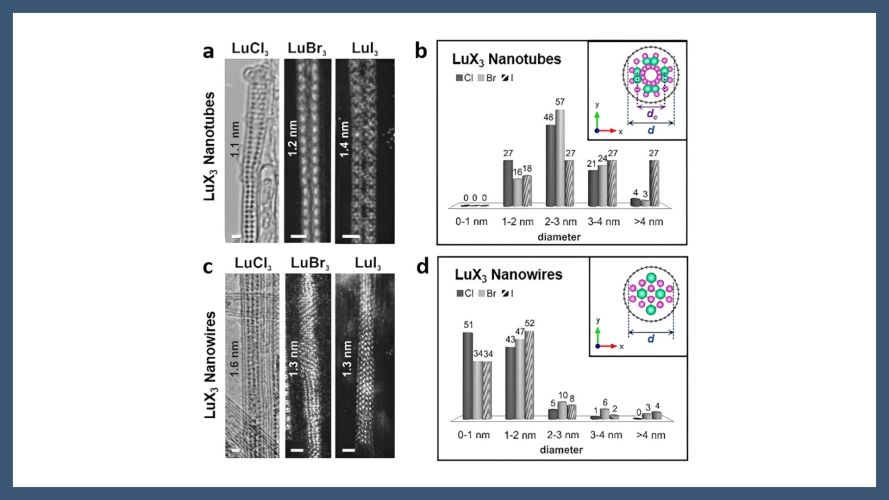
The inherent flexibility of individual layers in 2D materials enables them to be rolled up into tubular structures, thereby combining the properties of 1D and 2D materials and further expanding their range of applications. Even greater opportunities arise when two or more layers of different materials are combined, forming 1D tubular van der Waals heterostructures. Herein, the synthesis, structural characterization, and electronic properties of narrow 1D van der Waals heterostructures with internal diameters as low as ≈1 nm are reported. These are achieved by template-assisted growth of highly crystalline, single-layer lutetium halide (LuX3, X = Cl, Br, I) nanotubes confined within the cavities of single-walled carbon nanotubes. Aberration-corrected electron microscopy, along with image simulation, is employed to evaluate the role that the halide plays in the formation of such narrow heterostructures. The crystal structure of the employed halides is determined by means of synchrotron radiation, and density functional theory (DFT) calculations of the resulting metal halide nanotubes reveal a rich relationship between chirality and electronic/optical properties. The observed spatial separation of band-edge states can be important for photovoltaic applications, facilitating the separation of photogenerated electron-hole pairs.
M4HTH Smart Nanomedicine
Narrow-Diameter Tubular One-Dimensional van der Waals Heterostructures
Pach, Elzbieta; Kierkowicz, Magdalena; Kurttepeli, Mert; Frontera, Carlos; Borghesi, Costanza; Giorgi, Giacomo; Rurali, Riccardo; Bals, Sara; Van Tendeloo, Gustaaf; Tobias-rossell, Gerard; Ballesteros, Belen
DOI: 10.1002/smll.202505767

