


A new paper has been published in Nature Communications:
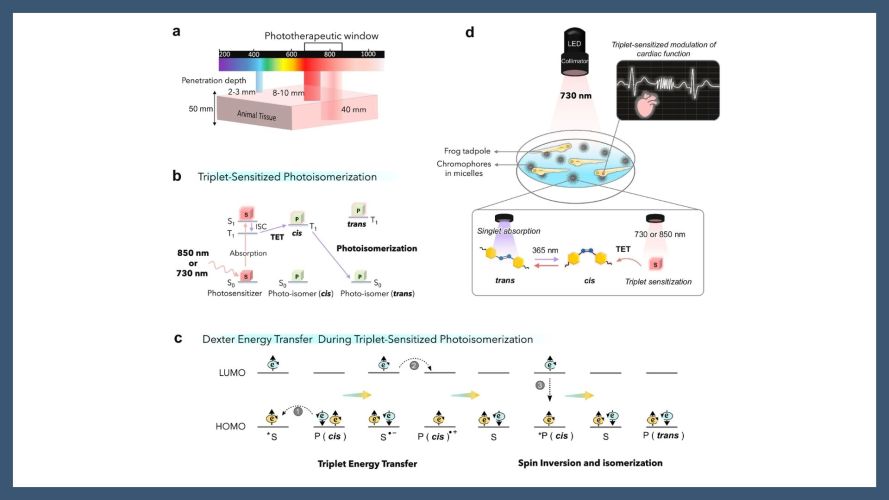
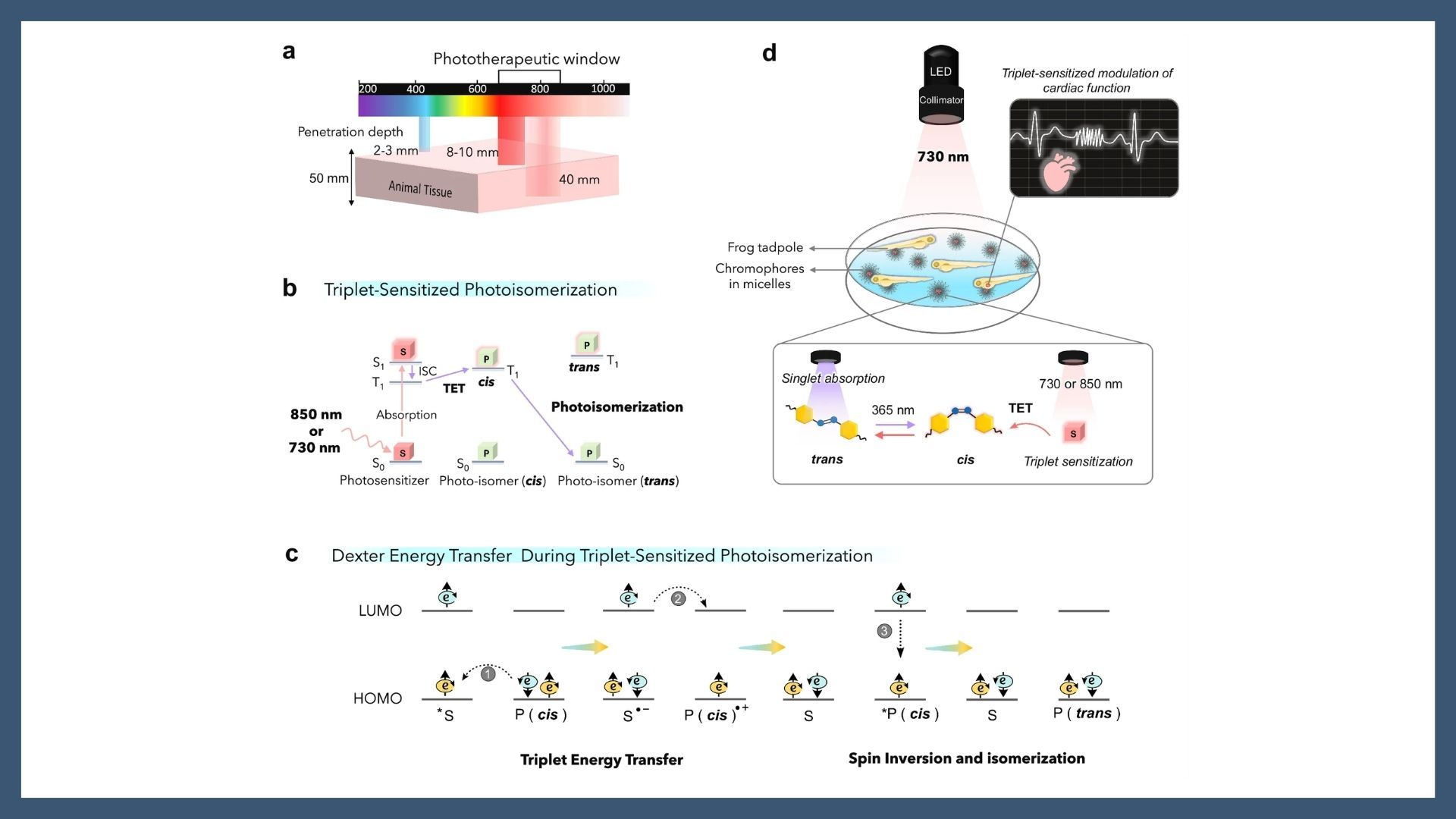
Red, far red, or near-infrared photoswitchable drugs offer immense photo-pharmacological advantages due to the higher light penetration through the skin. Such photoactivation is achieved using processes such as two- and three-photon absorption, excited-state absorption, and triplet-triplet annihilation upconversion, which require higher photon fluences (W to kW cm−2) than the resilience constraints of skin (200 mW cm−2). Herein, a generalized approach of cis-to-trans photoisomerization of azobenzenes is demonstrated via triplet sensitization with NIR-I illumination (850 nm) of a new Zn-octa-substituted phthalocyanine photosensitizer, in aqueous medium at 2.62 mW cm−2. The approach is applied to control the heart rate of a frog tadpole via cis-to-trans photoisomerization of an azobenzene-functionalized muscarinic acetylcholine receptor M2 agonist in the phototherapeutic window (730 nm excitation: 42 mW cm−2). This advance highlights a powerful photo-pharmacological strategy for modulation of in vivo activity at 2-4 orders of magnitude lower photon fluences of NIR light compared to established methods.
M4HTH Smart Nanomedicine
Noninvasive cardiac modulation via triplet-sensitized photoswitching in the phototherapeutic window
Naimovicius, Lukas; Miroshnichenko, Mila; Opar, Ekin; Holzel, Helen; Morikawa, Masa-aki; Kimizuka, Nobuo; Dapkevicius, Manvydas; Lekavicius, Justas; Radiunas, Edvinas; Kazlauskas, Karolis; Cilleros-Mane, Victor; Riefolo, Fabio; Matera, Carlo; Harmandar, Kevser; Taniguchi, Masahiko; Dumoulin, Fabienne; Lindsey, Jonathan S.; Bharmoria, Pankaj; Gorostiza, Pau; Moth-Poulsen, Kasper

