



A new paper has been published in the journal Physical Review D.
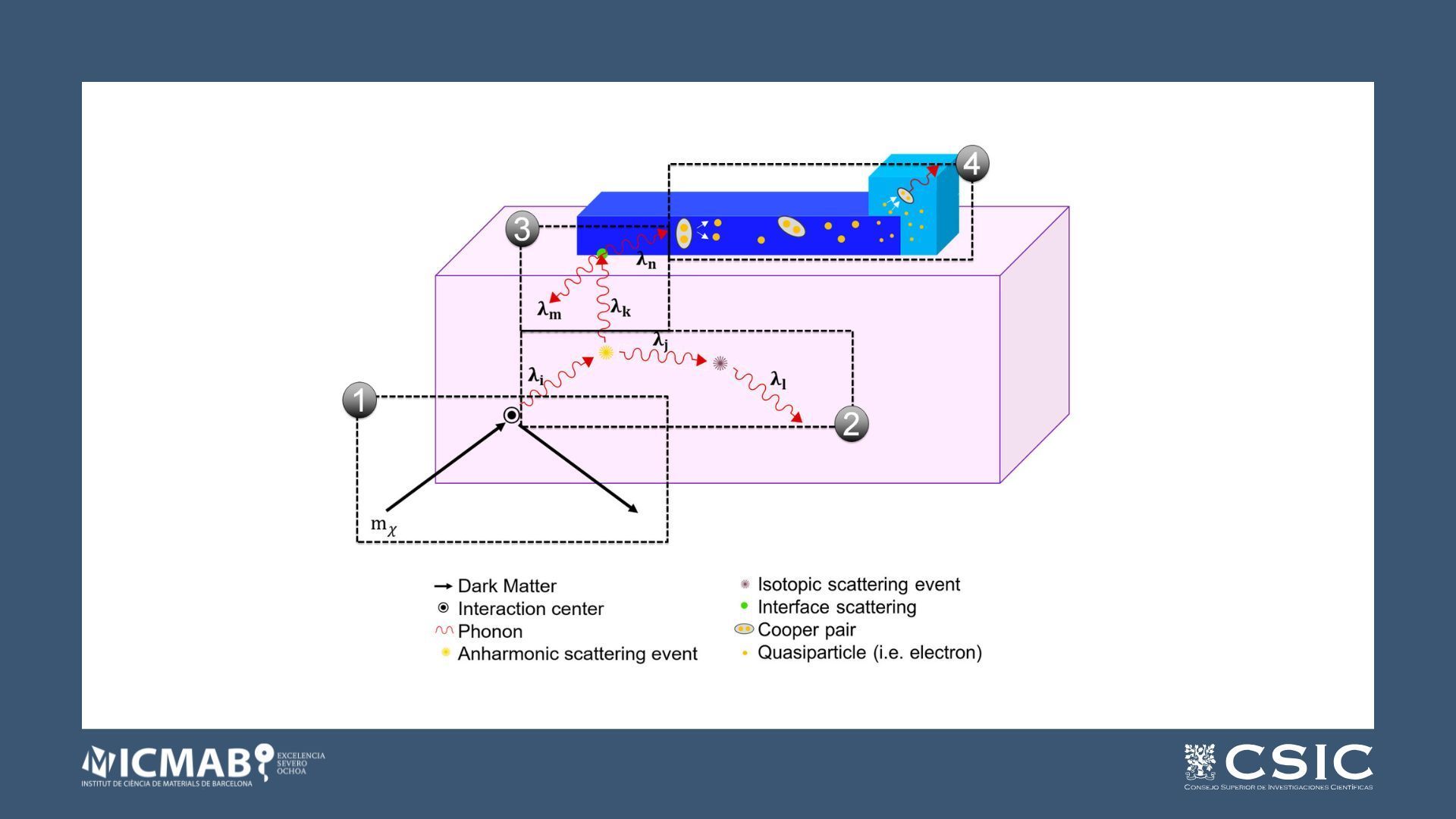
Thus, understanding the processes that can limit the performance of these detectors can be crucial for evaluating the feasibility of the proposed new detection schemes and, eventually, designing the detectors and tuning their performance. In this paper, we focus on a promising detection scheme, the excitation of single optical phonons in polar materials, to evaluate one of the possible and less understood limiting factors of cryogenic thermal detectors, i.e., the phonon dynamics in the target/absorber. We present a detailed theoretical analysis, within an entirely ab initio scheme, of the downconversion and propagation processes undergone by optical phonons, created by the interaction of a low-mass DM particle in an Al2O3 target, until they reach the interface with a phonon Al collector. After a preliminary methodological survey that reveals the limitations of any relaxation time approximation (RTA)-based method, we develop a beyond-RTA phonon Monte Carlo for three-dimensional materials that allows us to introduce the spatial dimension of the device and address questions about the impact of target size and scattering position.
M4NRG Clean Energy
Phonon dynamics for light dark matter detection
Martí Raya-Moreno, Bradley J. Kavanagh, Lourdes Fàbrega, and Riccardo Rurali
Phys. Rev. D 110, 112007

