


A new paper has been published in Inorganic Chemistry Communications:
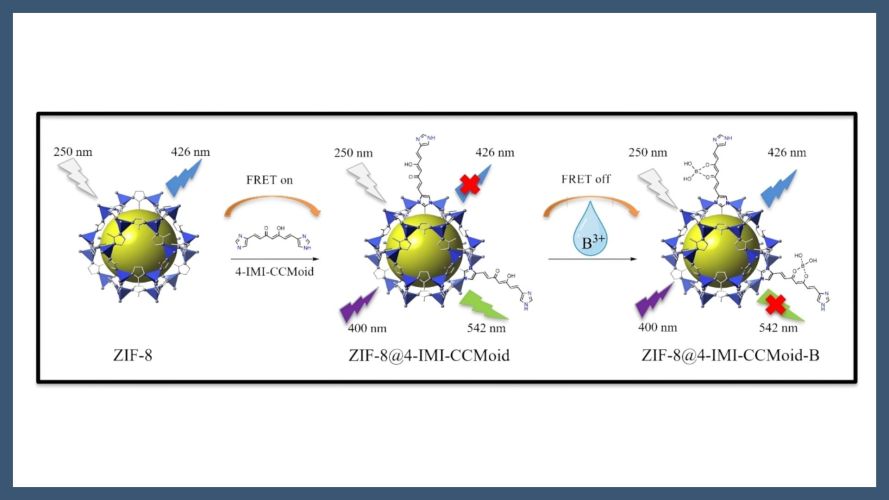
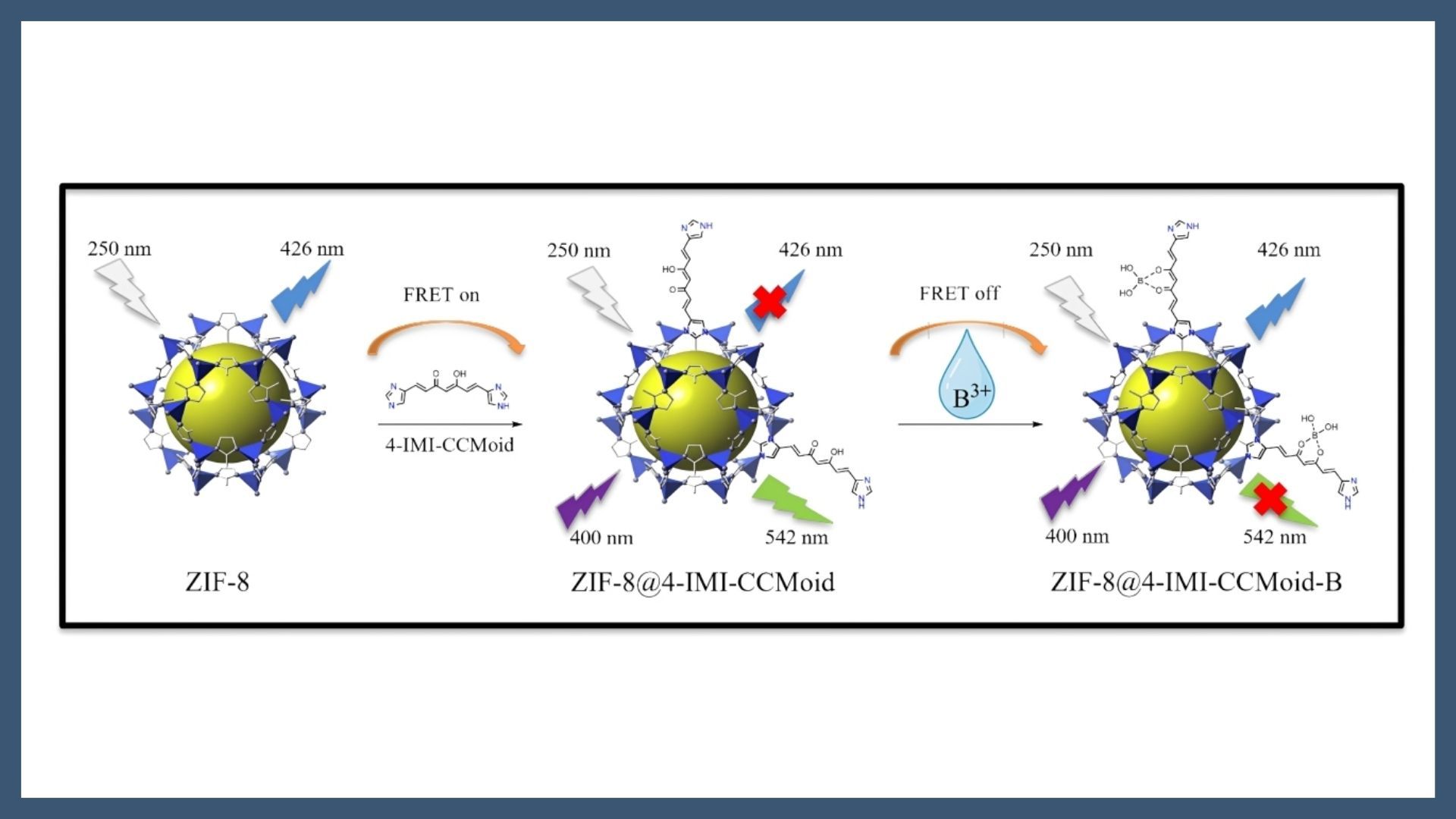
The development of selective and accessible fluorescent sensors for ionic species remains a key challenge. Herein, we report a curcuminoid (CCMoid)-functionalized ZIF-8 (ZIF-8@4-IMI-CCMoid) prepared via a post-synthetic surface ligand exchange strategy, where an imidazole-terminated CCMoid is anchored onto the ZIF-8 surface through Zn N coordination. Partial exchange generates pendant CCMoid fragments exposed to analyte interaction. The hybrid exhibits dual fluorescence: intrinsic ZIF-8 emission at 426 nm (λex = 250 nm), significantly attenuated upon CCMoid coordination, and a CCMoid emission band at 542 nm (λex = 400 nm), red-shifted relative to the free ligand. This behavior is consistent with an efficient Förster resonance energy transfer (FRET) process from the ZIF-8 framework (donor) to the CCMoid moieties (acceptor). Upon addition of boric acid (H3BO3), a pronounced recovery of the ZIF-8 emission at 426 nm was observed, accompanied by quenching of the CCMoid emission. This response is attributed to formation of a borate-CCMoid adduct, which perturbs the acceptor electronic structure and disrupts the FRET process, restoring MOF-centered fluorescence. This mechanism enables a highly sensitive dual-excitation response toward boric acid in aqueous media, with a detection limit of 1.05 μM, highlighting the potential of CCMoid-modified ZIF-8 as an efficient fluorescent probe for boron detection.
M4ELC Sustainable Electronics
Post-synthetic modification of ZIF-8 with an imidazole-based curcuminoid for selective sensing of boric acid in water
Campos-Olguin, A.; Iribarra-Araya, J.; Berlanga, I.; Pizarro, N.; Riveros, Ana L.; Kogan, M. J.; Aliaga-Alcalde, N.; Soler, M.
DOI: 10.1016/j.inoche.2026.117120

