


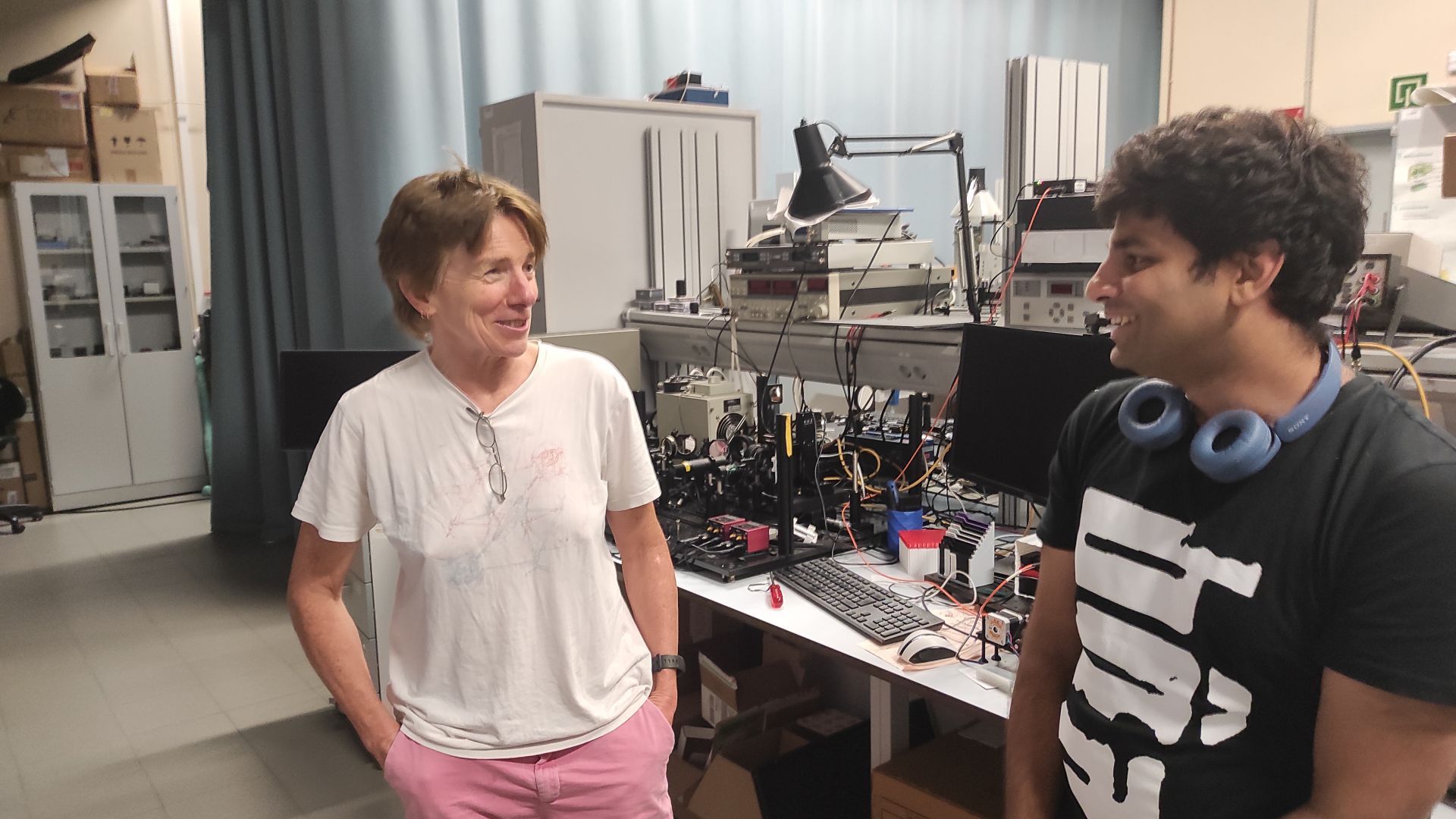
Jenny Nelson, chairholder of the DOMMINO project, visited ICMAB in order to discuss the project, which is funded in the framework of the JAE Chairs pilot program of the CSIC and FGCSIC. Nelson works at the Department of Physics at Imperial College London, UK. The DOMMINO project is coordinated by researcher Mariano Campoy Quiles, from the Institute of Materials Science of Barcelona (ICMAB-CSIC).
The goal of this visit was to get to know the researchers working at ICMAB, as well as to start with preliminary talks and the organization of the project tasks.
During her visit, she met with different ICMAB researchers, as well as visited the NANOPTO laboratories and the general laboratories of the ICMAB. On her visit she also met with the Director, and concluded by having a nice coffee break at ICMAB terrace, in order to get to know the people in a more informal way.
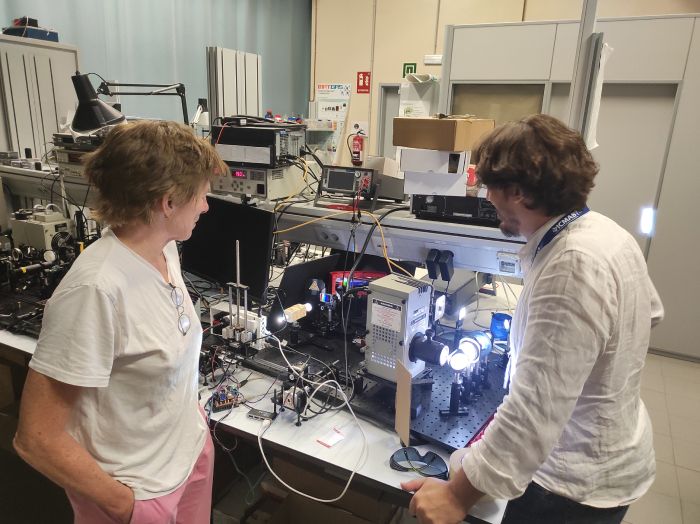
Nelson and Campoy at the NANOPTO lab
Regarding the visit, Mariano Campoy-Quiles said: "This has been a great opportunity for ICMAB researchers to have one to one meeting with Jenny Nelson and thus begin to lay the fundations for future collaborations. It has been a real pleasure to host her these days, and I am looking forwards to the formal kick off meeting of the project next month!"
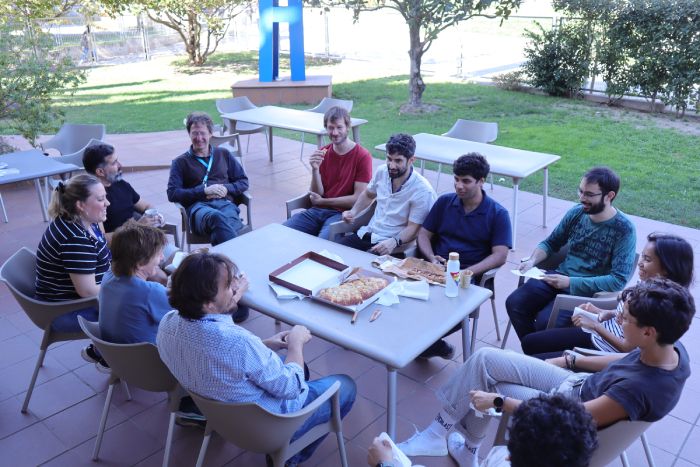
Having coffee with the NANOPTO group and ICMAB staff
About the project
DOMMINO (Design and Optimisation of Molecular Materials for Innovative Energy Solutions) targets the basic science of electronic materials that can help accelerate the energy transition. Identifying molecular semiconductors as designer materials with rapid design and scale-up potential as well as tuneable properties, the project aims to discover the design rules that will improve device performance in three critical areas. These are, improved thermoelectric harvesting of waste heat, improved energy efficiency of low power electronic devices, and improved utilisation of solar radiation for photovoltaic conversion.
Our approach is to combine the expertise of the CSIC researchers in experimental and high-throughput exploration with the Chair’s in innovative materials modelling, to discover the relationships that control the electronic, thermal and doping behaviour of target materials and so to develop criteria for improved materials. The findings stand to benefit development of thermoelectric, photovoltaic and low-power electronics technology and attract industrial interest.
Read more:
