


A new paper has been published in Materials Horizons:
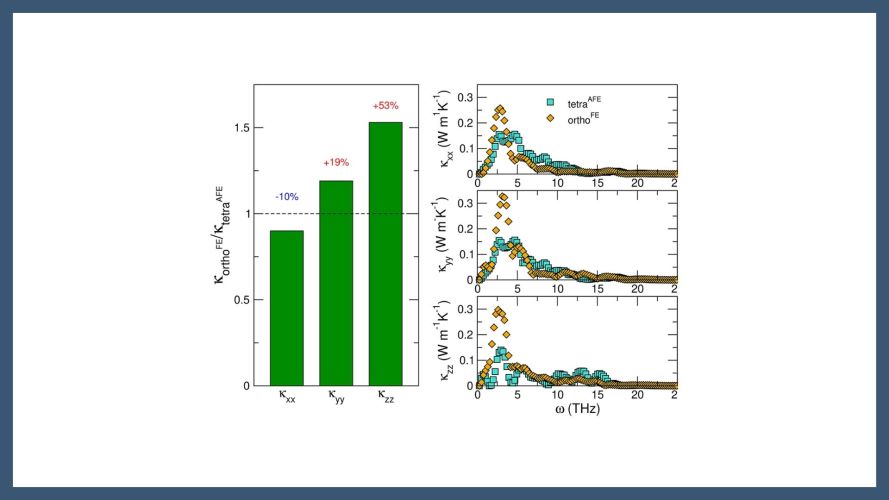
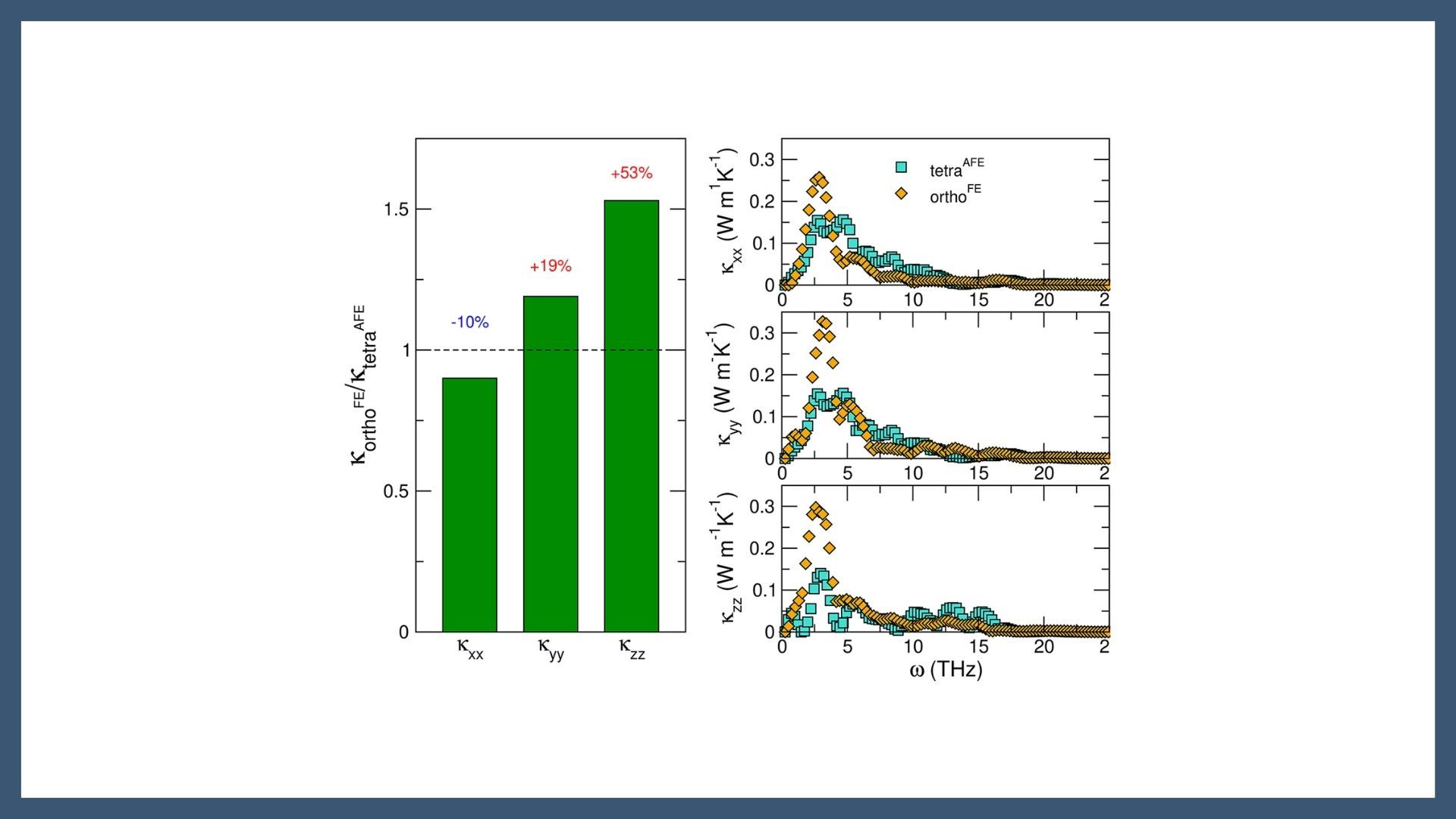
The ability to dynamically tune the lattice thermal conductivity, k, of solids would enable real-time control of heat flux, a key requirement for emerging applications in phonon-based logic, thermal memories, and energy-harvesting technologies. For such schemes to become practical, thermal transport must be switchable through fast and experimentally accessible stimuli, such as electric or magnetic fields or light absorption. Here, using first-principles calculations, we demonstrate that the electric-field-induced antiferroelectric-to-ferroelectric phase transition in ZrO2, where the crystal structure transforms from tetragonal to orthorhombic, provides an effective route to achieve this control. We show that higher-order anharmonic processes are essential to quantitatively describe both the absolute thermal conductivities of the two phases and their variations across the transition. Our results reveal an overall increase in k when nonpolar tetragonal ZrO2 converts into its ferroelectric orthorhombic counterpart, with the largest modulation (≈50%) occurring along the long axis of the tetragonal/orthorhombic cell. This sizable and anisotropic thermal response offers a promising mechanism for designing electrically controlled thermal-management devices such as thermal memories and thermal transistors.
M4NRG Clean Energy
Room-temperature electrical control of thermal conductivity in ZrO2
Cappai, Antonio; Benitez, Pol; Lopez, Cibran; Cazorla, Claudio; Rurali, Riccardo
DOI: 10.1039/d6mh00729e

