


A new paper has been published in the journal Aggregate:
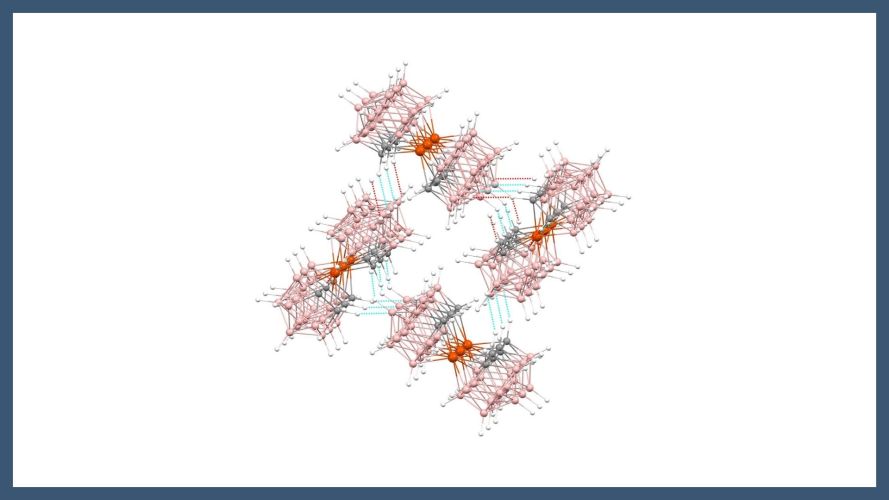
Coulomb's law predicts that like-charge ions repel and avoid dimerization. However, a class of dimers between like-charge ions is characterized. The [3,3’-Fe(1,2-C2B9H11)2]− (abbreviated as [o-FESAN]−) represents an innovative non-classical inorganic anion apart from hydroxyanions that exhibits anion-anion stabilization via dihydrogen bonding. Experimental methods (nuclear magnetic resonance [NMR], dynamic light scattering [DLS], and X-ray diffraction) and theoretical approaches (density functional theory) reveal that [o-FESAN]− clusters aggregate by overcoming long-range electrostatic repulsion. The synthesis of [H3O][o-FESAN]•3H2O and its crystal structure confirm the formation of stabilized anion-anion aggregates, with [H3O]+ counterions residing freely in the channels rather than between the anionic clusters. The structure exhibits the cisoid rotamer, which facilitates the ability of the anionic [o-FESAN]− cluster to form interactions stabilized by dihydrogen bonds (head-to-middle cluster) shorter than the sum of the Van der Waals radii. These shorter bonds are crucial for the formation of anion-anion interactions mediated by dihydrogen bonds. X-ray structures show that anions aggregate in the solid state, overcoming long-range electrostatic repulsion through dihydrogen bonds, which are distinct from the hydrogen bonds commonly observed in anion systems involving highly electronegative elements. Consistent with crystal structure evidence, 1H NMR, transmission electron microscopy, and DLS confirm [o-FESAN]− anion-anion aggregates in solution. Theoretical calculations support the formation of these anion-anion aggregates, primarily via Ccluster-H···H-B bonds. While individual B-H···H-B interactions are weakly attractive, their cumulative effect significantly enhances aggregate stability. Additionally, the crystal structure of Na(H2O)3[o-FESAN] is reported and analyzed, providing further evidence of unconventional interactions stabilized by dihydrogen bonds.
M4HTH Smart Nanomedicine
Stabilizing Anion–Anion Aggregates via Dihydrogen Bonds in Non-Classical Inorganic Molecules
Zaulet, Adnana; Nuez-martinez, Miquel; Hirva, Pipsa; Sillanpaa, Reijo; Teixidor, Francesc; Vinas, Clara
DOI: 10.1002/agt2.70228

