


A new paper has been published in the journal ACS Applied Materials and Interfaces:
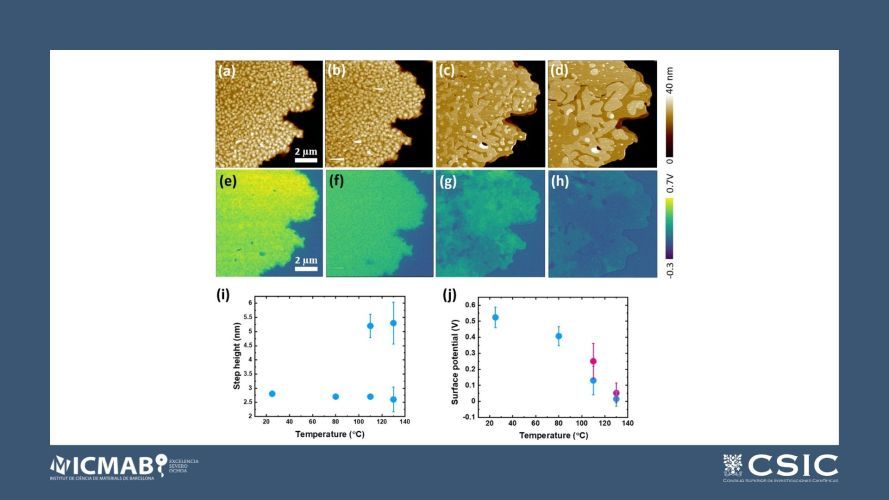
The influence of the film/substrate interface and the role of film thickness on the structural transition temperature for thin films of the asymmetric BTBT derivative 7-decyl-2-phenyl[1]benzothieno[3,2-b][1]-benzothiophene (Ph-BTBT-10) have been addressed by using Kelvin probe force microscopy (KPFM) and synchrotron grazing incidence wide angle X-ray scattering (GIWAXS). Our data strongly suggest that the structural transformation from a single-layer phase to the thermodynamically stable bilayer structure develops from the bottom of the film to its surface. Contrary to observations in other organic semiconductor films, notably, the thinner the Ph-BTBT-10 film, the lower is the transition temperature. This unusual behavior is attributed to the ubiquitous presence of a bilayer at the substrate interface.
The evolution over time of an ultrathin film with ≈3 nm nominal thickness (below the interfacial bilayer completion) shows that molecular diffusion and rearrangement at room temperature lead to the bilayer stacking within hours, a result that further supports the role of the bilayer interface on the structural transition from single-layer to bilayer structure. Our findings highlight that both aging and thermal annealing processes need to be optimized based on the specific thickness of the Ph-BTBT-10 film.
M4ELC Sustainable Electronics
Thickness Dependent Structural Transition in Ph-BTBT-10 Thin Films and Stabilization of the Ubiquitous Interface Bilayer
Shunya Yan, Alba Cazorla, Eduardo Solano, Ute Zschieschang, Hagen Klauk, Carmen Ocal & Esther Barrena
ACS Appl. Mater. Interfaces 2025, 17, 2, 4176–4184

