

A new paper has been published in ACS Applied Electronic Materials:
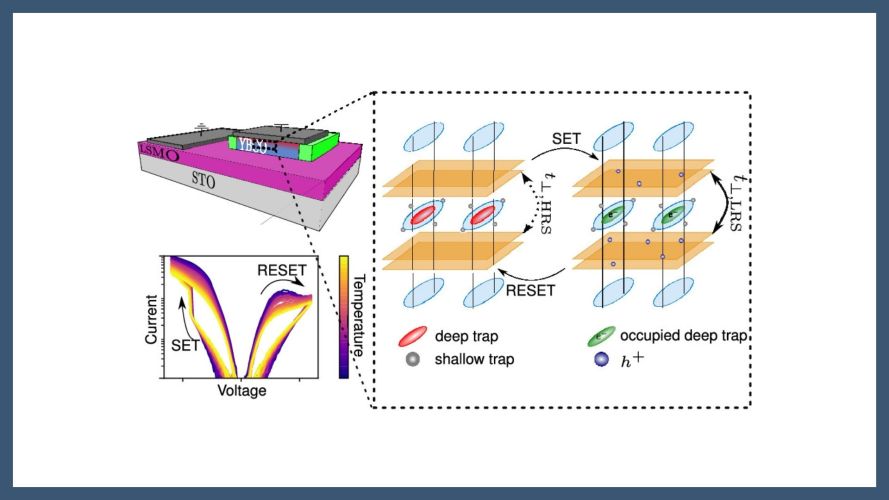
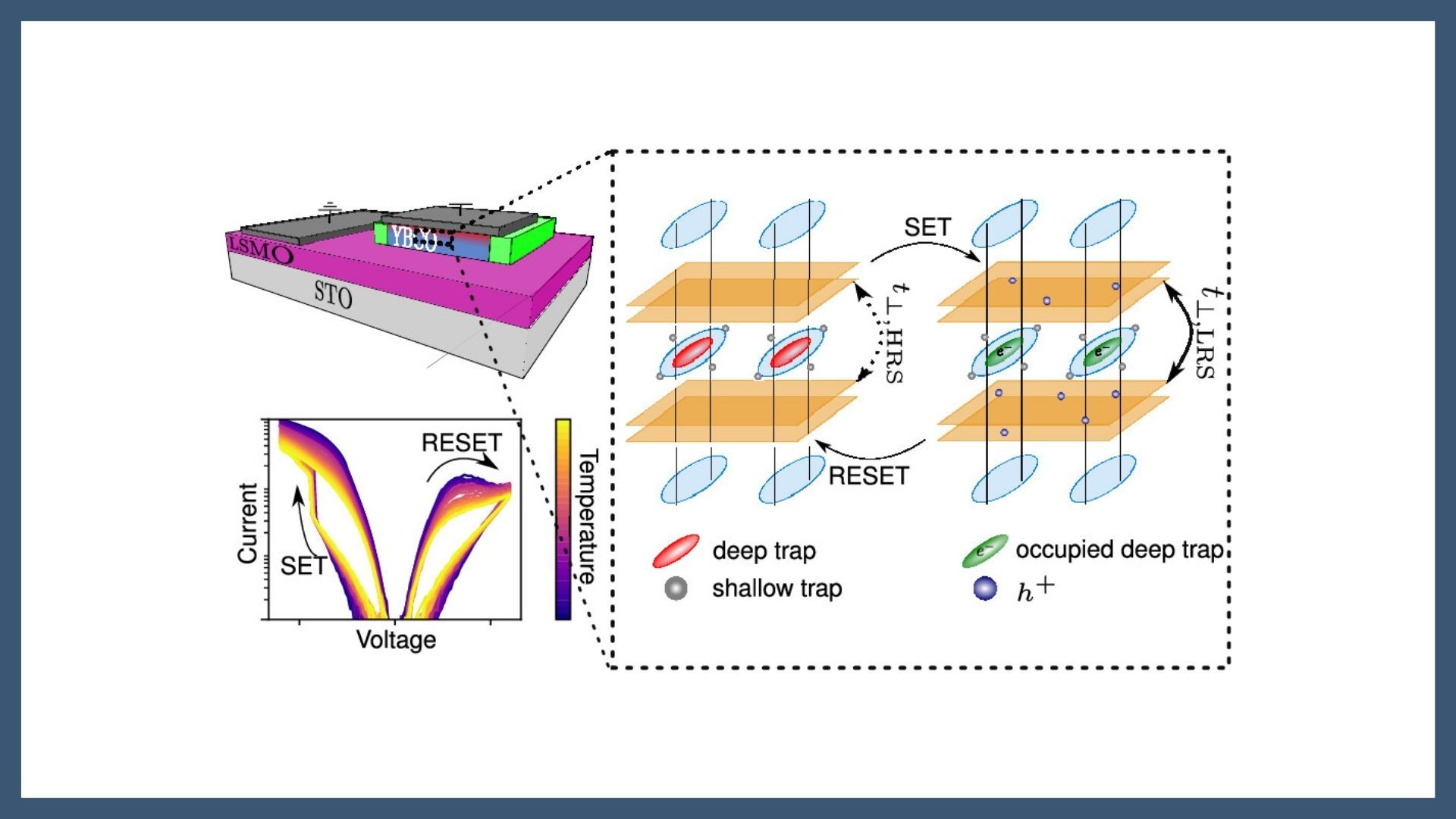
Memristive devices based on high-temperature superconducting cuprates offer promising routes for neuromorphic computing, yet the microscopic mechanisms governing their resistive switching remain unclear. Here we investigate YBa2Cu3O7−δ (YBCO) memristors across 80–300 K, revealing robust bipolar switching between high- and low-resistance states with temperature-independent SET and RESET voltages. Current–voltage analysis shows both states follow trap-controlled space-charge-limited conduction, modulated by shallow and deep trap states at an oxygen-deficient interfacial YBCO layer. A key enabler of this behavior is the formation of a deoxygenated layer beneath the top contact, which acts as a dynamic trap region and allows electrostatic control over a field-induced metal–insulator transition. We propose a dual-trap model where deep traps linked to CuO chain fragmentation stabilize a field-induced metal–insulator transition, enabling nonvolatile switching. These insights elucidate the role of trap dynamics in cuprate memristors and highlight their potential for cryogenic neuromorphic platforms compatible with superconducting computing architectures.
M4ELC Sustainable Electronics
Trap-Controlled Conduction and Metal–Insulator Transition in Superconducting Cuprate Memristors
Gunkel, Thomas; Miranda, Enrique; Balcells, Lluis; Mestres, Narcis; Palau, Anna; Sune, Jordi
DOI: 10.1021/acsaelm.5c02017

