


A new paper has been published in ACS Nano:
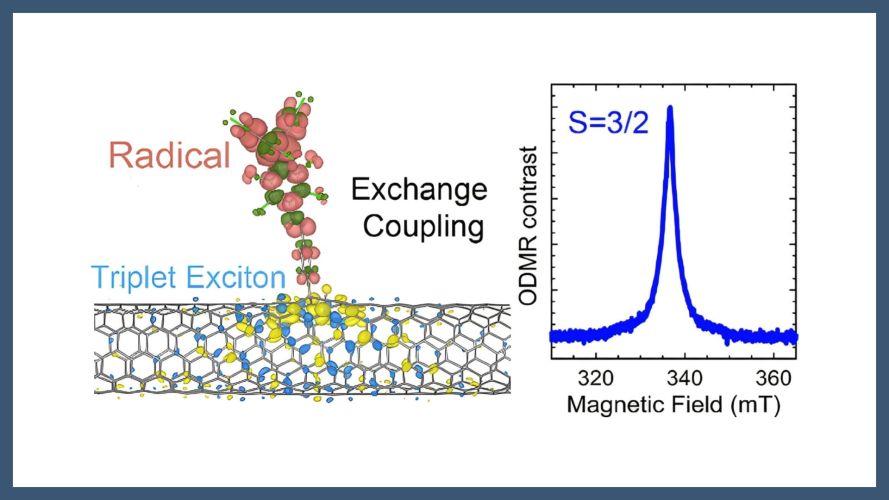
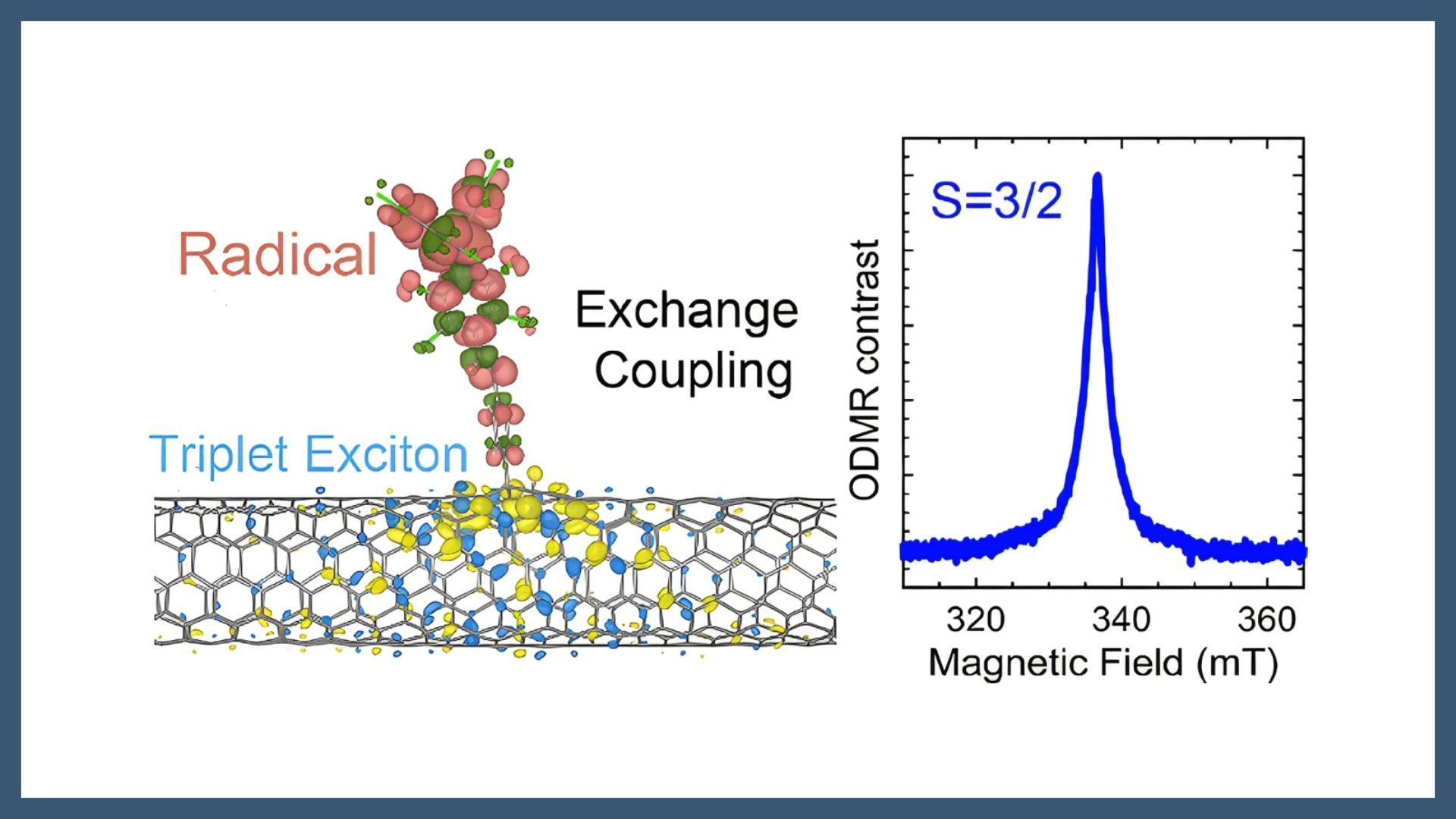
Manipulation of triplet states lies at the origin of the emerging applications in quantum sensing and spin-based optoelectronics. In this work, we employ optically detected magnetic resonance (ODMR) spectroscopy to investigate how sp3 functionalization of (6,5) single-walled carbon nanotubes (SWCNTs) influences triplet exciton (TE) behavior. Functionalization with closed-shell 4-nitrophenyl groups at varying defect densities reveals that similar to singlet excitons, the TEs localize at the defect sites, leading to reduced zero-field splitting (ZFS) parameters and a distortion from the axial symmetry typically observed for pristine tubes. ODMR contrast is highest at low defect densities, suggesting that interdefect interactions significantly affect TE generation and spin polarization. Density functional theory (DFT) confirms the experimental observations that a reduced ZFS is observed for the sp3-functionalized SWCNTs. Open-shell (radical) functionalization introduces strong exchange interactions between the radical’s unpaired electron and the TEs, resulting in an effective S = 3/2 system with enhanced ODMR contrast. These findings highlight how tuning the nature and spatial arrangement of sp3 defects offers a powerful strategy to control TE dynamics in SWCNTs, toward their integration into advanced quantum materials and devices.
M4ELC Sustainable Electronics
Tuning Intersystem Crossing to Triplet Excitons in sp3-Functionalized (6,5) Carbon Nanotubes through Defect Density and Functional Groups
de Sousa, J. Alejandro; Settele, Simon; Biktagirov, Timur; Djafari, Jamila; Gerstmann, Uwe; Goovaerts, Etienne; Zaumseil, Jana; Crivillers, Nuria; Cambre, Sofie
DOI: 10.1021/acsnano.5c09734

