


A new paper has been published in the Journal of Applied Physics:
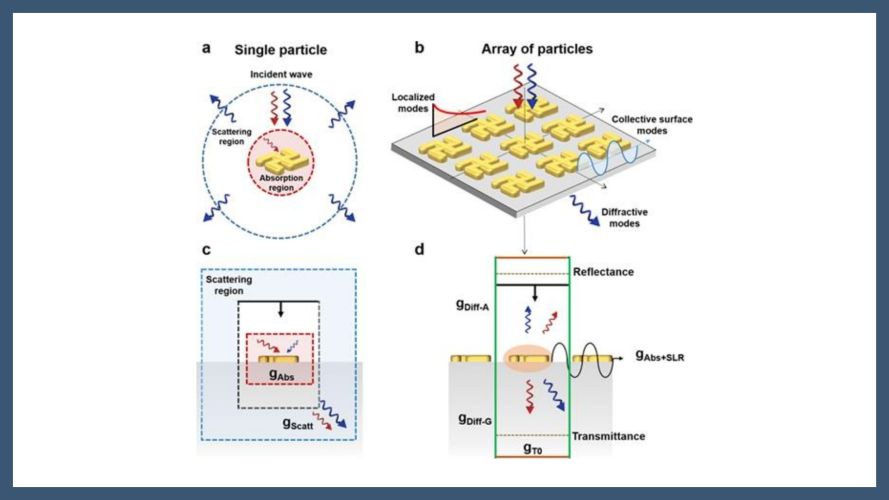
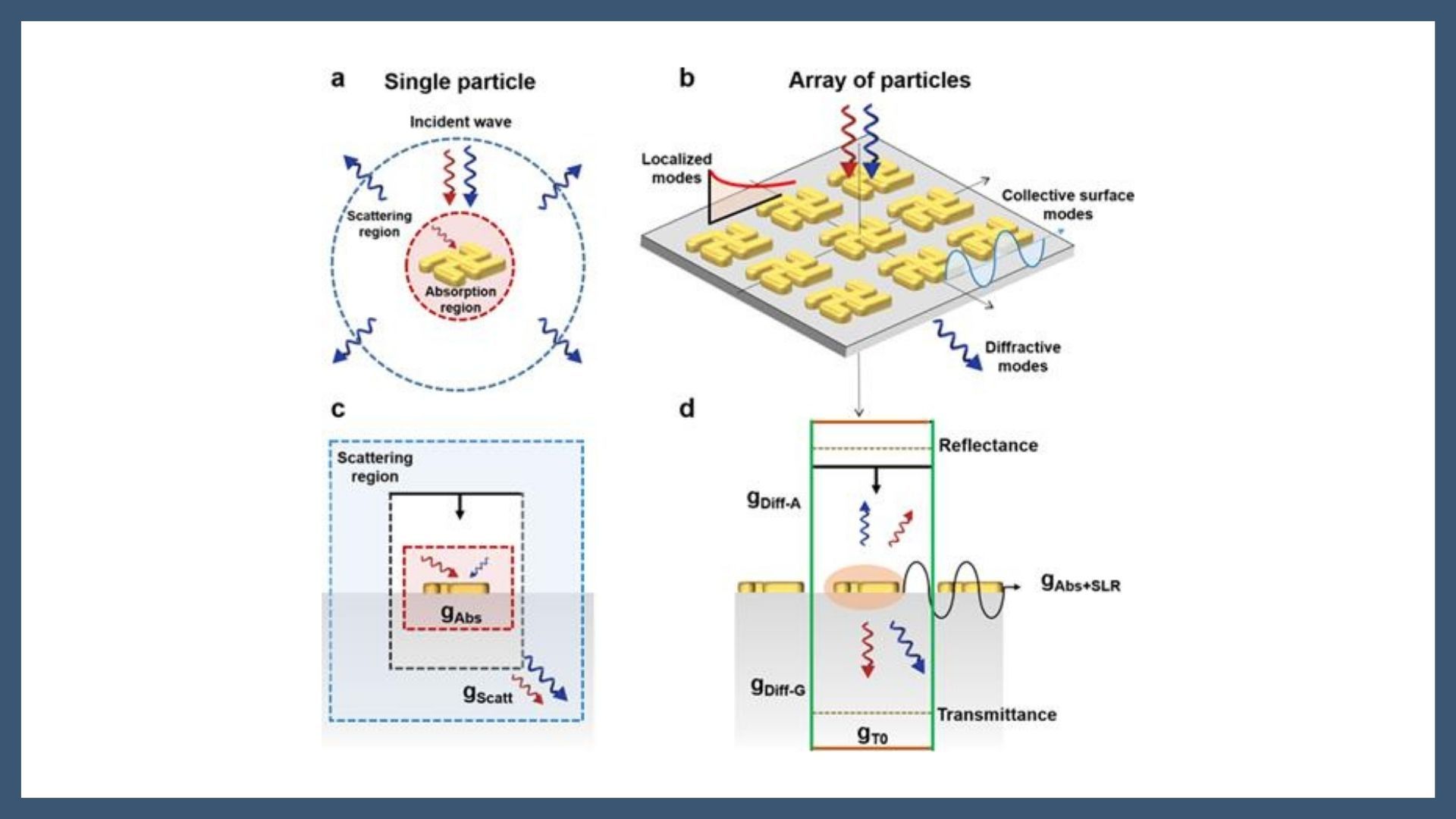
Enabling chiral light emission from arbitrary emitters by using their coupling to two-dimensional (2D) chiral arrays offers an efficient and flexible strategy to take advantage of the best suited emitters. The chiral grating can be independently fabricated using well-known and stable materials. In order to design and optimize the photonic architecture, fundamental understanding of the mechanisms at play is necessary, including its chiral lattice resonances and how they affect the chiral photoluminescence of the emitters. In this work, we perform finite-difference time-domain simulations to explore these aspects in 2D gratings coated by different functional materials, namely, a dielectric, TiO2, and a metal, Au, to understand the role of their varied optical properties on the final results. The chiral structure consists of a square array of gammadions, which is one of the most reported chiral geometries due to its simplicity and fourfold symmetry preventing linearly polarized components. The results show how to benefit from collective resonances to maximize the obtained circularly polarized emission depending on each material and the resulting different origins of the collective interactions.
M4NRG Clean Energy
Understanding the origin of circularly polarized light emission induced by coupling to two-dimensional chiral arrays using different functional coatings: Dielectric vs plasmonic
Mendoza-Carreno, J.; Mihi, A.; Alonso, M. I.
DOI: 10.1063/5.0313838

