

The program Science by Women, promoted by Mujeres por África Foundation, consists of a 6-month post-doctoral fellowship program in collaboration with recognized Spanish Centers of Excellence, thus ensuring excellence in scientific research in various fields. Since its first edition, the program has involved 31 entitites and supported over 150 talented African women, fostering a strong network of African women scientists who contribute significantly to their home countries’ development. The 10th edition aims to further this legacy, exceeding 175 beneficiaries and continuing to build the N.O.W. IS Africa network, which connects past fellows and promotes international scientific cooperation.
Science by Women is based on the capacity of African women researchers to lead the continent’s transition to an economy basedon knowledge and innovation. It seeks to address the social, structural and economic barriers that limit their participation in science and technology in order to reduce the gender gap in these fields for the long-term progress and equitable growth of African countries.
In ICMAB we have proudly participated since the 7th edition in 2021.
7th EDITION, 2021
Assumpta Chinwe Nwanya, from Nigeria
On Spring 2022 Assumpta arrived to join the LASER group under the supervision of Ángel Pérez. She worked on the project "Development of low-cost, high-capacity graphene and silica from rice husk for energy storage applications", which looked into how to use biomass rice husk waste material to synthesize high-capacity graphene and its derivatives for energy storage applications.
By synthesizing graphene and its derivatives from biomass rice husk waste for use in energy storage devices such as supercapacitors and batteries, this work not only offers a sustainable solution for renewable energy storage but also provides an environmentally friendly way to manage agricultural waste. This research can help mitigate the intermittency of abundant solar and wind energy in Nigeria, paving the way for more reliable energy systems. Moreover, scaling up this innovation could transform local industries, driving cleaner energy and environmental sustainability.
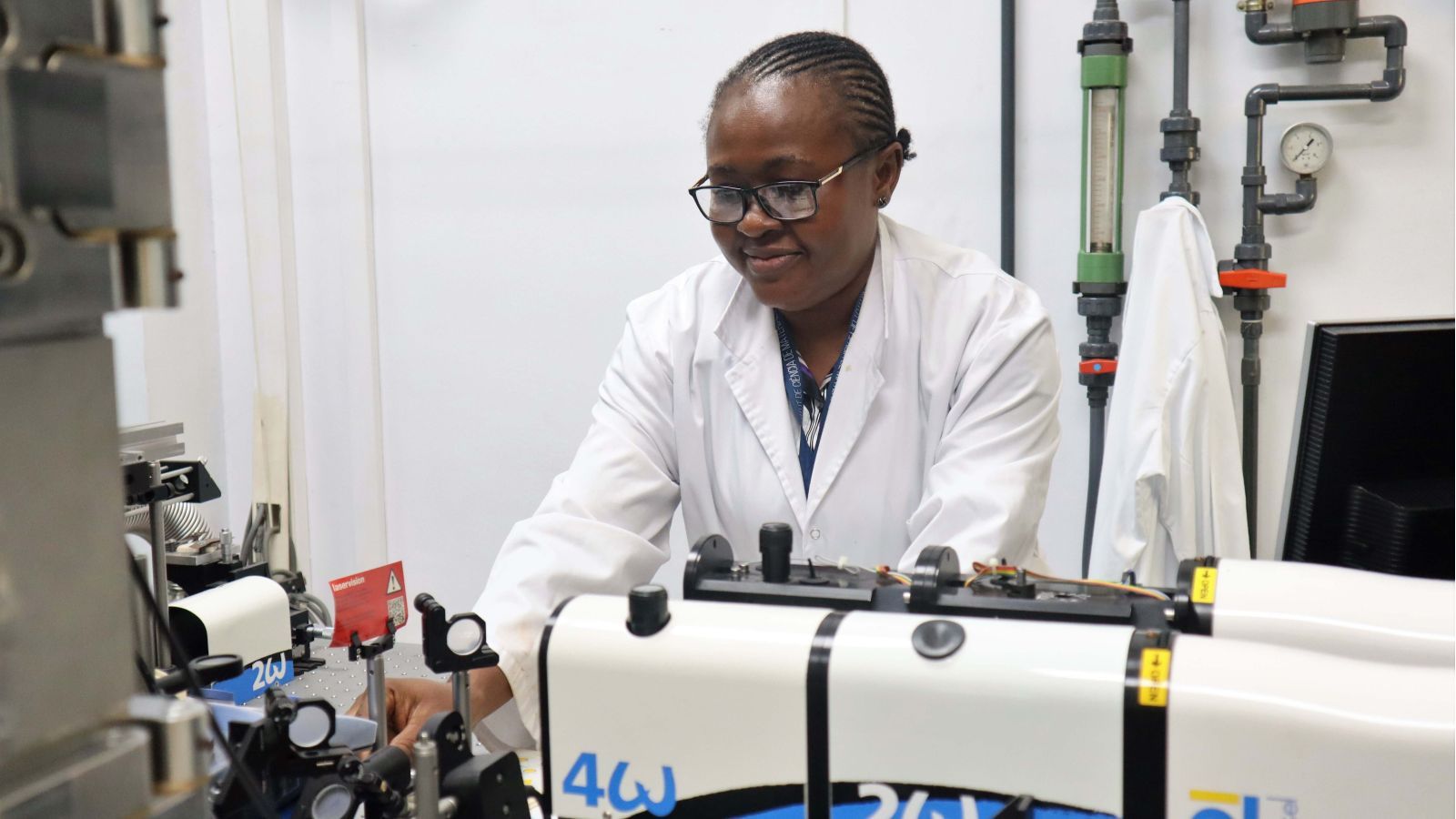
Nwanya, Assumpta Chinwe in the Laser Processing Lab (7th edition) | ICMAB-CSIC
8th EDITION, 2022
Miranda Mengwi Ndipingwi, from CameroonMiranda was going to come and join Nieves Casañ in the Electrochemistry group in the project "Design and fabrication of ternary mixed polyoxometalates as materials for flow cells in sustainable energy storage", but unfortunately she couldn't come due to medical reasons.
9th EDITION, 2023
Muthumuni Elizabeth Managa, from South Africa
Muthumuni arrived at ICMAB on the 16th of January of 2025 to join the Inorganic Materials and Catalysis (LMI) group under the supervision of Rosario Nuñez. She will work on the project "Photophysical properties of Porphyrins modified with Boron icosahedral clusters for biomedical applications". The biomedical application of nanoscale materials for diagnosis and therapy is a highly promising area of research, where coordination chemistry plays a pivotal role. Among these materials, porphyrinoids (such as porphyrins and phthalocyanines) are well-known photosensitizers for photodynamic therapy (PDT). Porphyrins can be excited with visible light to produce reactive oxygen species (ROS), which induce irreversible oxidative damage to target cells.
However, metal-free porphyrins suffer from poor photostability and a tendency to aggregate in aqueous solutions, limiting their effectiveness. To address these challenges, there is a pressing need to design new porphyrins with reduced aggregation and improved stability. In parallel, boron clusters, with their three-dimensional structures, high boron content, and low toxicity in biological systems, represent excellent candidates for biomedical applications. They are particularly attractive as pharmacophores in the design of boron carriers for Boron Neutron Capture Therapy (BNCT). The proposal focuses on developing novel porphyrin-boron cluster conjugates for anticancer therapy, integrating the mechanisms of PDT and BNCT. By combining these two complementary therapies, this approach aims to advance innovative and effective treatments for cancer, bridging chemistry and biology in a multidisciplinary strategy.
She will stay here until the 15th of April 2025 and then come back on July of this same year.
Yasmin Abo Zeid, from Egypt
On the 28th of February of this year, 2025, Yasmin will arrive at ICMAB to participate in two different groups: Nanomol-Bio, under the supervision of Imma Ratera, and the Inorganic Materials and Catalysis (LMI) group, under the supervision of Rosario Nuñez. Her research project will be: "Derivatives of boron cluster compounds as surface modification strategy to combat infections". This project is based on surface modification of solid materials by self-Assembly Monolayer (SAM), a well-developed technique at ICMAB by Imma Ratera from the Nanomol-Bio Group. The tecnhnique will be exploited to modify solid surfaces with derivatives of boron cluster compounds (e.g. COSAN derivatives) prepared by Rosario Nuñez from the LMI Group.
COSAN-derivatives are proposed in this project for surface modification to control and prevent infections associated with medical devices such as catheters and implants. These compounds have demonstrated antimicrobial activity, with microorganisms being less likely to develop resistance to them. Moreover, they are biocompatible and environmentally friendly, making them ideal for medical applications. The project will leverage the complementary expertise of the two ICMAB groups involved, applying a SAM (Self-Assembled Monolayer) strategy to anchor COSAN molecules onto gold surfaces via SH-anchoring. This initial step will validate the hypothesis before extending the work to materials commonly used in medical devices. The project will then assess the antibiofilm activity of these modified surfaces against multidrug-resistant (MDR) bacteria using established protocols developed by the ICMAB-CSIC Bioservice.
10th EDITION, 2024
Manoko Maubane-Nkadimeng, from South Africa
For the Science by Women edition of 2024, we are excited to welcome Manoko Maubane-Nkadimeng this September 2025 to ICMAB. She will join Mariano Campoy's group, NANOPTO, to work on the project "Enhancing the thermoelectric properties of PEDOT:PSS using carbonised nitrogen-doped carbon dots." This innovative research aims to synthesize composites of carbon nanomaterials and the conductive polymer PEDOT:PSS, evaluating their performance in converting heat energy into electricity through thermoelectric effects. The project has the potential to significantly advance thermoelectric materials, opening up new possibilities for sustainable energy harvesting and waste heat recovery.
Read more:
- ICMAB - "The outcome of my research at ICMAB can be applied in my country, Nigeria" (ICMAB, July 2022)
- ICMAB debuts in the "Science by Women" program in its 7th edition (ICMAB, 23 March 2022)
- ICMAB joins the 7th edition of the Science by Women programme (ICMAB, 22 Sep 2021)
- ICMAB will be part of the programme "Science by Women" of the Women for Africa Foundation (ICMAB, 2 Oct 2020)
