

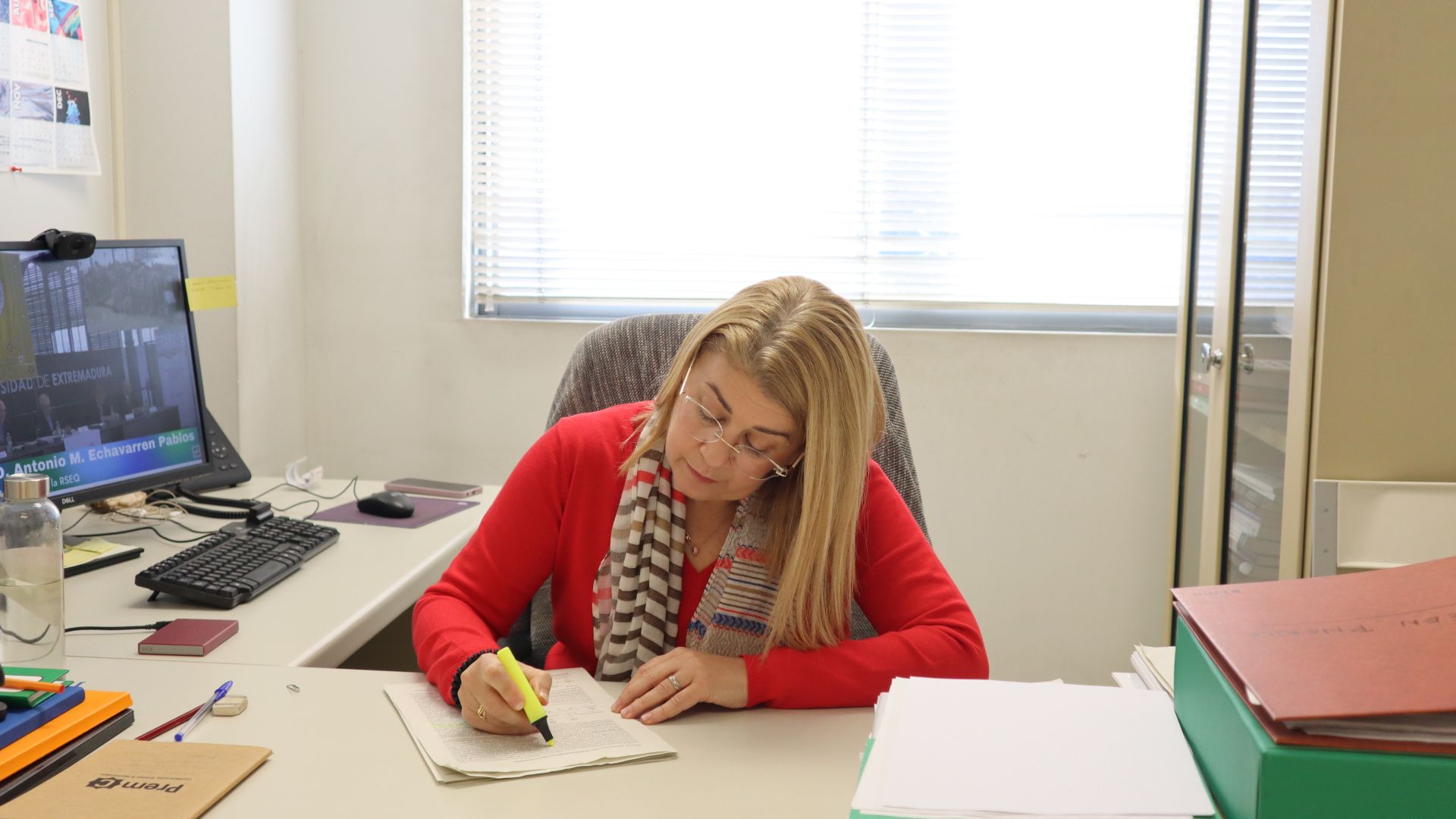
Rosario Núñez (Loja, Granada) has been at the Institute of Materials Science of Barcelona (ICMAB-CSIC) since 1992, “practically since the centre was inaugurated.” Here, she completed her doctoral thesis in the Laboratory of Inorganic Materials and Catalysis (LMI), under the supervision of Clara Viñas. Previously, she had obtained her degree in Chemistry from the University of Granada in 1991 and a Master's degree in Chemistry from the Autonomous University of Barcelona, where she later obtained her PhD in 1996.
“Out of these 33 years, I’ve only been away for three,” says Núñez. She refers to the three years she spent at the Université de Montpellier II as a postdoctoral researcher. In 1999, she came back to ICMAB as a contracted doctor in the LMI, led by Francesc Teixidor. Later, she obtained a permanent position as a Tenured Scientist and was then promoted to Research Scientist. Now, she is also part of Labsinlove (LiL), a new Technology-Based Company (EBT, also known as a spin-off) that aims to create new compounds for Boron Neutron Capture Therapy (BNCT), a promising technique in the fight against cancer.
A lifetime dedicated to research, and now you are part of a new spin-off, Labsinlove. How has that been?
I was already collaborating with Ignacio Porras’ research group from the Department of Atomic, Molecular and Nuclear Physics at the University of Granada, who is the pioneer behind the idea of creating this EBT. Ignacio is a nuclear physicist, and he has long been working with researcher Mari Carmen Ruiz, an immunologist, pharmacist, and biologist.
They had already been working with boron compounds for BNCT applications, and one day they called me to explain that they were considering setting up this spin-off and would like that I took part in it. At first, you think, “I don’t know if I’m ready for this,” but in the end, you say, “let’s take on this adventure!” In late September 2023, all the documentation was signed, and we hired Miquel Nuez, a postdoctoral researcher who currently works in the company’s R&D department, focusing on the synthesis and characterization of boron-based cluster compounds for their application in BNCT.
You mentioned being unsure if you were ready. What has been the biggest challenge you’ve faced in this process?
I had no idea how the whole process of transferring technology from the research laboratory to the company worked, although I hadn’t really thought about it before. LiL has as partners both the CSIC and the University of Granada, and the CSIC transfer department helped us with the agreement. So, no, I didn’t know what steps to take, but that wasn’t what worried me.
"Ignacio Porras has taken patients to Japan for BNCT treatment because they saw there was no other option here. They’ve seen that those people have improved, that there was a positive effect"
How will the compounds created by Labsinlove help society?
Some time ago, an article about Labsinlove was published in a newspaper from Granada, my hometown and where my family is from. One of my cousins, who is a nurse at the Hospital Virgen de las Nieves, told me, “I wish you could do something because we receive patients with those types of cancers. And you see that there is no solution for that.” I’m telling you this with the hope that what we’re doing at LiL will work in the future. Ignacio Porras has taken patients and sent them to Japan for BNCT treatment because they saw there was no other option here. They’ve seen that those people have improved, that there was a positive effect.
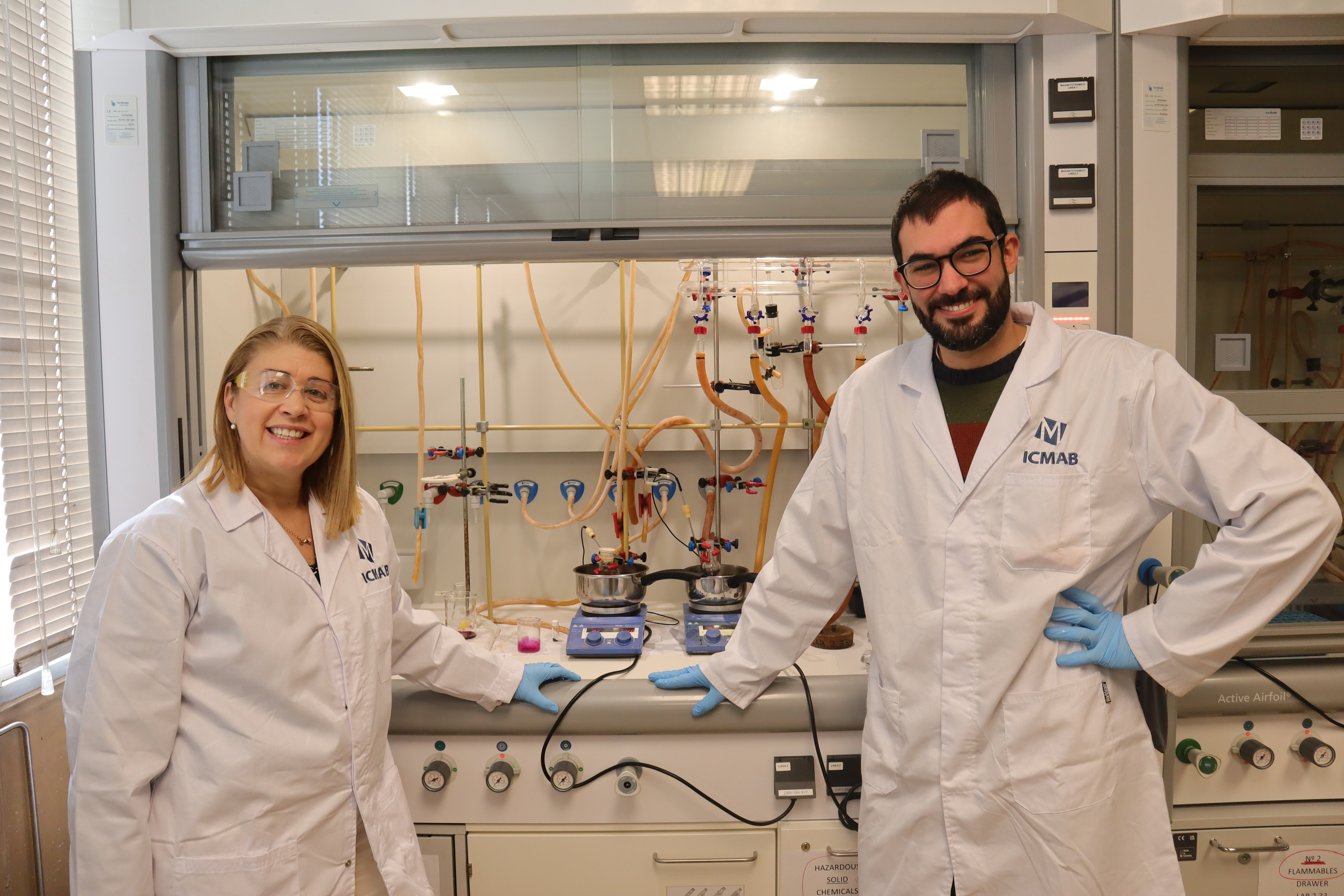 Rosario Núñez and Miquel Nuez pose at the Laboratory of Inorganic Materials and Catalysis (LMI) | ICMAB-CSIC
Can you explain more about what BNCT consists of?
I will try to explain it in a simple way: The element boron has two isotopes: boron-10 and boron-11. When boron-10 is irradiated with epithermal neutrons, a nuclear fission reaction occurs, forming boron-11, which is highly unstable and decays, producing lithium and alpha particles. The alpha particles are high in energy but have a short range. The idea is to accumulate a large amount of boron-10 in tumour cells and then irradiate it with neutrons. In this way, the reaction occurs selectively in these cells, killing only those marked by the boron and leaving healthy cells unharmed. It’s a very selective form of radiotherapy.
"Currently, there are about 15 projects worldwide installing these accelerators in facilities dedicated to BNCT at hospitals and research centres"
Why isn’t this therapy more widespread?
Because you need a source of neutrons, and here’s the first problem: where do you get the neutrons from? Until today, they were obtained from nuclear power plants. Reactors similar to those in nuclear plants generate epithermal neutrons. So, you need a hospital next to a nuclear reactor, and this can only be done in a few places: the closest to us here in Europe was in Helsinki. Otherwise, you have to go to Japan, Taiwan, or Argentina. However, in recent years, there has been significant progress in the production of compact particle accelerators. These particle accelerators also generate neutrons and are small enough to be installed in a hospital. Currently, there are about 15 projects worldwide installing these accelerators in facilities dedicated to BNCT at hospitals and research centres.
What are the characteristics of the compounds you seek?
We want to develop a compound that has a lot of boron in its structure. Boron clusters can have between 10 and 18 boron atoms per molecule, and if we manage to introduce many clusters into a compound, we then have a boron-rich one. However, the most complicated challenge is selectivity: we need it to accumulate in tumour cells and not in healthy ones so that when we irradiate with neutrons, the reaction only happens in the tumour areas. Currently, many times, they accumulate in other organs, so we are looking for a molecule that recognises a receptor found on tumour cells and directs it there, guided by biological vectors.
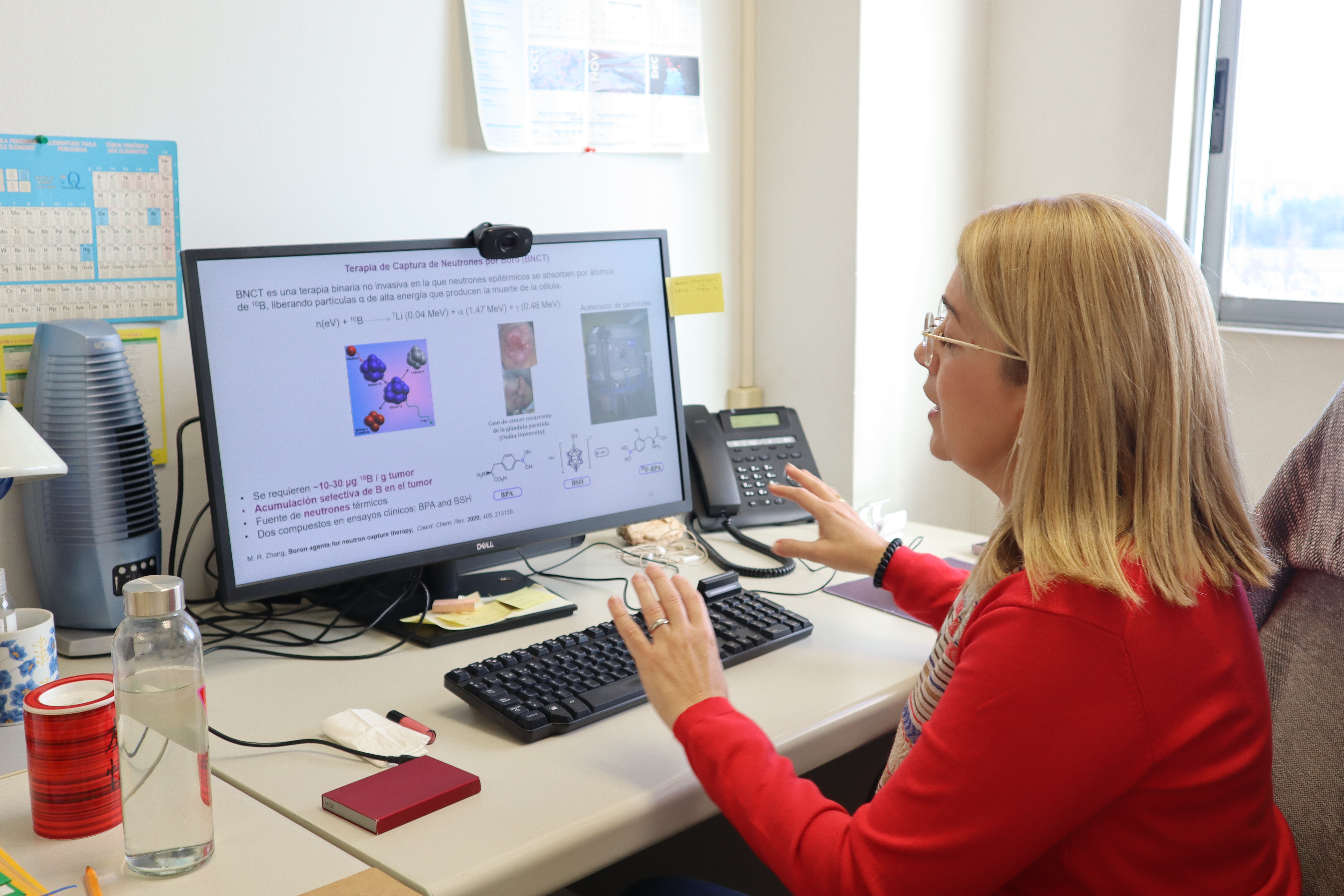 Rosario explaining what BNCT consists of | ICMAB-CSIC
What other challenges does LiL face?
So far, clinically, everything has been based on Borophenylalanine (BPA). Since all the protocols developed over the years have been for this compound, specialists are reluctant to use anything else because that would require revising the well-established protocols. They are often very reluctant to test other drugs, and there are often differing opinions because they also need to be willing to adapt their protocols.
I suppose a spin-off is a lot of work, but is there a possibility of another one?
Yes. And it’s for something totally different... I still cannot provide you with many details, but it is a spin-off about photocatalysis. We are currently working on creating the company, thanks to an Impulsa-T project, which CSIC conceeded us and funds the creation of Technology-Based Companies. Unlike Labsinlove, this one has nothing to do with medical applications; it’s an environmental topic, because the photocatalysis we work with is achieved under very sustainable conditions.
Read more:
- The spin-off LabsinLove wins gold medal at AcexHealth Investor Day for advancing cancer therapy
- Development of a radiolabeled nanomaterial to improve current theranostics for cancer
- Muthumuni Managa: "Collaboration between institutions is essential because it enhances one's scope in terms of research"